
Classic 3-Day Private Sahara Tour
Ait Ben Haddou, the Dades Valley, the Todra Gorge and a night in an Erg Chebbi desert camp. The best balance of time and experience.
See the day-by-day plan
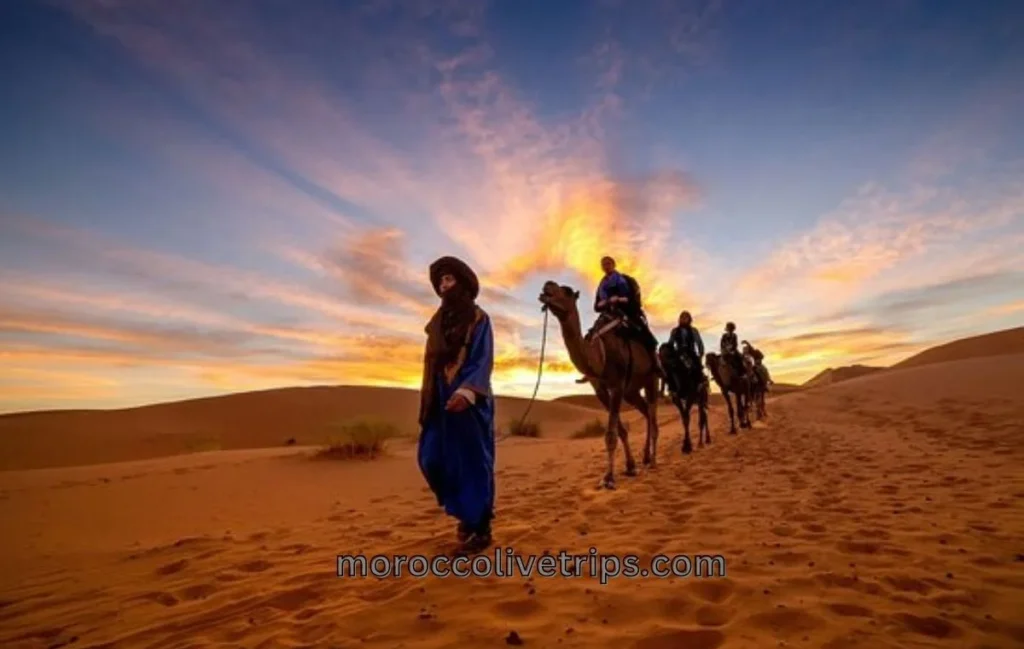
Travel from Marrakech to the Sahara in your own air-conditioned vehicle with an English-speaking driver-guide. Cross the High Atlas, explore Ait Ben Haddou and the Todra Gorge, ride camels into the Erg Chebbi dunes at sunset and sleep in a desert camp, all at your own pace.
Marrakech to the Sahara, your way
The road from Marrakech to Merzouga is one of the great journeys in North Africa. In a little over 550 kilometres it climbs over the High Atlas, drops into a land of earthen kasbahs and palm oases, threads through two dramatic gorges and finally runs out of tarmac at the edge of Erg Chebbi, the tallest sand sea in Morocco. Done well, it is the highlight of a Morocco trip. Done badly, crammed into a minibus with fifteen strangers and a fixed timetable, it can feel like two very long days on a bus.
A private tour from Marrakech to Merzouga changes that. The vehicle, the driver-guide and the timing are yours alone. You choose when to leave in the morning, where to stop for photographs, how long to spend wandering Ait Ben Haddou, and whether to add an extra night so the driving never feels rushed. If someone in your group gets car sick, wants a longer lunch or simply needs a break, the day bends around them instead of the other way round.
Morocco Live Trips runs private Marrakech to Merzouga desert tours for couples, families, friends and small groups. This page explains everything you need to decide: how many days to choose, the route and real driving times, what you will see each day, what the desert camp is like, what is included, the best time of year to go and how booking works. When you are ready, send us your dates and we’ll reply with a tailored itinerary and a clear price.
If you are still comparing options across the whole country, our guide to private Morocco tours with a driver covers longer routes, and our Morocco tour packages page lists every itinerary we run.
Want to know who you’ll be travelling with? Meet our team on the local Morocco tour company page.
Short on time or want more than the desert? Compare our other Morocco tour packages, or plan a tailor-made Morocco tour that adds Fes, Chefchaouen or the coast.
Every hotel lobby and riad in Marrakech sells desert tours, and most of them are shared group trips. They are cheap because they fill a minibus, follow a fixed schedule and use large camps on the edge of the dunes. For some travellers that is fine. For many others, especially families, couples on a special trip, older travellers and photographers, the private option is worth far more than the difference in price.
Here is what changes when the tour is private:
We’ve written a full, honest comparison in private driver vs group tour in Morocco. In short: if you value time, comfort and flexibility on a journey of more than 1,000 kilometres there and back, a private tour almost always wins.
| Private tour | Shared group tour | |
|---|---|---|
| Who’s in the vehicle | Only your group | Usually 10–17 travellers |
| Departure time | You choose | Fixed early-morning departure |
| Stops and timing | Flexible, as long as you like | Set stops, set times |
| Pickup | At your riad or hotel | Often a central meeting point |
| Hotels on the route | Your choice of level | Fixed, usually budget |
| Desert camp | Standard or luxury, your choice | Large shared camp |
| Start and end | Marrakech, Fes or airport | Marrakech only, in most cases |
| Best for | Families, couples, seniors, photographers | Solo travellers on a tight budget |
Shared tours have their place. If you are travelling alone on a tight budget and happy to follow a fixed plan, they are an inexpensive way to see the dunes. But for most couples, families and small groups, the difference in comfort, flexibility and the quality of the experience is significant, and once the cost of a private vehicle is shared between two, four or six people, the gap in price is often smaller than travellers expect. A private tour also tends to mean a quieter camp, a slower pace at the places you care about and a driver-guide whose attention is on your group rather than a busload of strangers.
It is also worth thinking about what happens when plans change. On a private tour, if the weather turns or someone feels unwell, your driver can adjust the day, take a different road or add a rest stop. On a shared tour, the bus keeps to its schedule.
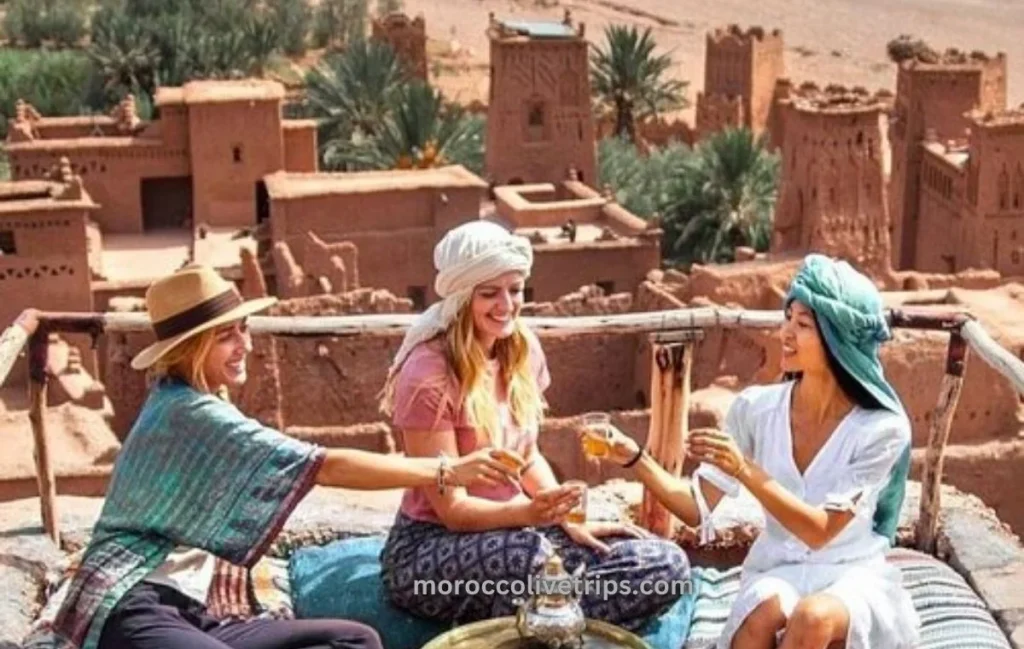
Tell us your dates, the number of travellers and whether you’d like to finish in Marrakech or Fes. We’ll send a private itinerary and a clear price with no obligation.
The distance from Marrakech to Merzouga is roughly 550 to 560 kilometres each way, and the drive takes about nine to ten hours without stops. How many days you choose decides how much of that time is spent sightseeing rather than simply driving. These are the private routes our guests choose most often; each one can be adjusted.
Ait Ben Haddou, the Dades Valley, the Todra Gorge and a night in an Erg Chebbi desert camp. The best balance of time and experience.
See the day-by-day plan
Cross the Sahara and finish in Fes instead of driving back, via the cedar forests and the Middle Atlas. Ideal if you are heading north.
See the route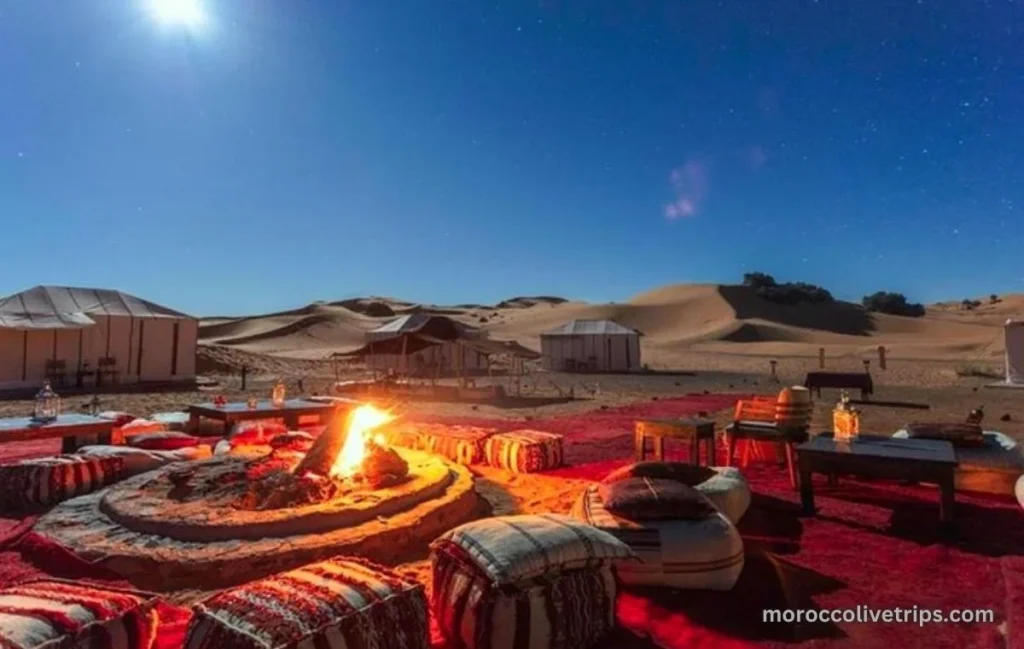
Shorter driving days, a full afternoon in the dunes and time for Skoura, Rissani and the Gnawa village of Khamlia.
See the 4-day plan
Possible if you are short of time, but with long driving days. We’ll explain honestly whether it suits you, or whether a closer desert is better.
Is 2 days enough?Most private tours follow the same classic route east over the Atlas and along the “road of a thousand kasbahs”, because it passes almost every major sight between Marrakech and the Sahara. The times below are approximate driving times without stops; with photo stops, visits and lunch, each day is longer. Your driver-guide will plan the stops around your interests and the light.
| Stage | Approx. distance | Approx. driving time | Highlights |
|---|---|---|---|
| Marrakech to Ait Ben Haddou | 190 km | 3.5–4 hours | High Atlas, Tizi n’Tichka pass (2,260 m), Berber villages |
| Ait Ben Haddou to Ouarzazate | 30 km | 30 minutes | Taourirt Kasbah, film studios |
| Ouarzazate to the Dades Valley | 120 km | 2 hours | Skoura palm grove, Rose Valley, kasbahs |
| Dades Valley to the Todra Gorge | 70 km | 1.5 hours | Tinghir oasis, Todra Gorge walk |
| Todra Gorge to Merzouga | 200 km | 3 hours | Erfoud, Rissani, first views of Erg Chebbi |
| Merzouga to Marrakech (return) | 550–560 km | 9–10 hours | Draa or Dades route back over the Atlas |
| Merzouga to Fes (alternative end) | 470 km | 7–8 hours | Ziz Valley, Midelt, Ifrane, cedar forest |
The longest single drive is always the return from Merzouga to Marrakech. That is why many travellers either add a fourth day to break it up or finish the tour in Fes, which is closer to the desert. If you are flying home from Fes or continuing to Chefchaouen and Tangier, ending in Fes saves you a full day of backtracking.
Good to know: the Tizi n’Tichka road is a well-maintained national highway, but it has many bends. If anyone in your group is prone to motion sickness, tell us in advance; your driver will drive gently, stop more often and seat them in front.
This is our most popular private route and the one we recommend for most first-time visitors. It gives you a full day of Atlas and kasbah scenery, a relaxed afternoon in the dunes and a night in the Sahara. For the full detail of this exact trip, see our private 3-day Marrakech to Merzouga desert tour page. For a closer look at the dunes, camps and desert activities on this route, read our 3-day Merzouga desert tour guide.
Your driver-guide collects you from your riad or hotel in Marrakech in the morning, usually between 7:30 and 8:30. Within an hour the city gives way to the foothills of the High Atlas, and the road begins to climb through walnut groves and red-earth Amazigh villages towards the Tizi n’Tichka pass at 2,260 metres, the highest major road pass in Morocco. On a clear day the views back across the range are spectacular, and there are plenty of places to stop for photographs and a coffee.
Descending the southern side, the landscape changes completely: green valleys become ochre hills and the first earthen kasbahs appear. In the late morning you reach Ait Ben Haddou, the fortified village (ksar) listed as a UNESCO World Heritage Site and used as a backdrop in films and series such as Gladiator and Game of Thrones. Cross the river, walk up through the lanes of mud-brick houses and climb to the old granary at the top for the view over the valley. A local guide can be arranged on request.
After lunch, continue through Ouarzazate, past the Taourirt Kasbah and the film studios, then along the valley of kasbahs via the Skoura palm grove and the Rose Valley at Kelaat M’Gouna. You arrive in the Dades Valley in the late afternoon and spend the night in a comfortable hotel or guesthouse with dinner and breakfast included.
After breakfast, drive a short way up the Dades Gorge to see the famous winding road and the rock formations known locally as the “monkey fingers”. Then head east to Tinghir, where a long ribbon of palm groves runs beneath the mountains, and on into the Todra Gorge. Here the canyon walls rise around 300 metres on either side and narrow to a few metres at the most dramatic point. Walk along the river through the gorge before lunch in the area.
The afternoon drive takes you through Tinejdad and Erfoud, past the fossil workshops and date palms of the Tafilalet, until the dunes of Erg Chebbi rise out of the flat desert like a wall of orange sand. At Merzouga you leave the vehicle (and any large luggage you don’t need), meet your camel handler and ride into the dunes as the sun sets. Arriving at camp, you’ll have mint tea, dinner, and an evening of Berber drumming around the fire under a sky full of stars.
Wake early to climb a dune for sunrise over the Sahara, one of the quietest and most beautiful moments of any trip to Morocco. After breakfast at camp, return to Merzouga by camel or 4×4, freshen up and begin the journey back to Marrakech. The return is a long day, roughly nine to ten hours with stops, crossing the Atlas again in the afternoon. You are dropped at your Marrakech accommodation in the evening.
If that final day sounds too long, there are two easy fixes: add a fourth day (see the 4-day option), or finish in Fes instead of Marrakech.

Send us your travel dates and group size. We’ll confirm availability, suggest the right camp and send you a clear price.
If you have the time, four days is the most comfortable way to do this trip. The extra day breaks up the long return drive, gives you a full afternoon to enjoy the dunes and lets you visit places the 3-day route passes too quickly. It is the version we suggest for families with young children, older travellers and anyone who would rather look out of the window than at the clock.
Cross the High Atlas over the Tizi n’Tichka pass, explore Ait Ben Haddou without hurrying and spend the night in a kasbah or guesthouse in the Skoura palm grove or near Ouarzazate. A shorter driving day means you arrive in time to relax before dinner.
Follow the valley of kasbahs through Kelaat M’Gouna and the Dades Gorge, then continue to Tinghir and walk through the Todra Gorge. Overnight in the Todra or Tinghir area.
Drive to Rissani, the old caravan town near the ruins of Sijilmassa, and visit its market. Continue to Khamlia, a village known for Gnawa music, before arriving in Merzouga in the afternoon. Ride camels into the dunes for sunset and spend the night at your desert camp.
Sunrise over the dunes, breakfast in camp, then the drive back to Marrakech or north to Fes. If you prefer, add a second night in the desert and split the return with a night in the Draa Valley.
You can see a similar route in more detail on our 4-day Marrakech to Fes desert tour, and if you want to add even more of southern Morocco, our 6-day itinerary through the Atlas Mountains and Merzouga is a good model.
If Fes, Chefchaouen or the north of Morocco is next on your list, there is no need to drive back to Marrakech. This route follows the same first two days as the classic tour, then on day 3 heads north from the desert through the Ziz Valley, the town of Midelt below the Middle Atlas, and the cedar forests near Azrou, where Barbary macaques often appear beside the road. You arrive in Fes in the late afternoon or early evening and are dropped at your riad.
Ending in Fes is popular with travellers on a one-way trip across Morocco, and the drive from Merzouga to Fes is noticeably shorter than the return to Marrakech. See the full route on our Marrakech to Fes desert tour page or the 3-day Merzouga tour ending in Fes.
We’re often asked whether Merzouga can be done in two days. It can, and we run it as a private trip, but we want you to know what it involves before you book. On a 2-day tour you spend most of each day in the vehicle: around nine to ten hours of driving on day 1 to reach the dunes for sunset, and the same on day 2 to return. There’s little time to explore Ait Ben Haddou or the gorges.
A 2-day trip can still be worth it if seeing the big dunes of Erg Chebbi is your priority and you genuinely have no extra day. If you are short of time and mainly want a desert night, a trip to the Zagora area or a night in the Agafay Desert near Marrakech involves far less driving, though the scenery is very different from the tall sand dunes of Merzouga. Read more about the express option on our 2-day tour from Marrakech to Merzouga page, or ask us and we’ll give you an honest recommendation.

A private tour is about the journey as much as the destination. These are the places you’ll pass, with an idea of what each one is like and how long to allow.
The road out of Marrakech climbs into the High Atlas, the mountain range that separates the plains from the pre-Sahara. Villages of stone and earth cling to the slopes, terraced fields line the valleys and, in winter and spring, the peaks can be capped with snow. At the Tizi n’Tichka pass you are more than 2,200 metres above sea level. It is a natural place to stop, stretch and take photographs before the descent.

The ksar of Ait Ben Haddou is the most famous earthen village in Morocco and a UNESCO World Heritage Site. Its tightly packed kasbahs climb a hillside above the Ounila river, and it has starred in many films and television series. Allow an hour to an hour and a half to walk up to the top and back.
Known as the gateway to the desert, Ouarzazate is home to the Taourirt Kasbah and large film studios. Most private tours pass through rather than stop for long, but you can add a studio or kasbah visit if it interests you.
East of Ouarzazate, the Skoura palm grove is dotted with old kasbahs, some of them now guesthouses. Further on, the Rose Valley around Kelaat M’Gouna is famous for the Damask roses grown along its fields and for its rose festival in May.
The Dades Valley is a long green oasis lined with kasbahs beneath red and ochre cliffs. A short detour up the Dades Gorge brings you to unusual eroded rock formations and the famous zigzag road that climbs the canyon wall, one of the most photographed roads in Morocco.
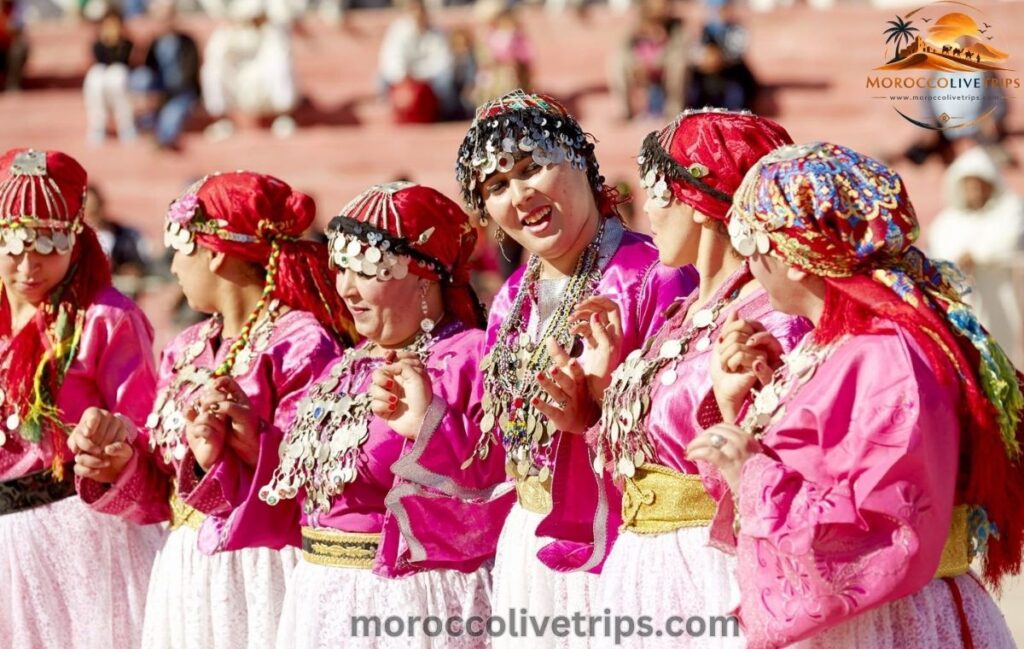
Tinghir sits above a long palm oasis that is beautiful from the viewpoints on the road. A few kilometres away, the Todra Gorge is the most dramatic canyon on the route, with sheer limestone walls rising roughly 300 metres and a clear stream running along its floor. Walking through the narrowest section is one of the highlights of the drive.
Erfoud is known for its fossil workshops, where marble rich in ancient marine fossils is cut and polished. Nearby Rissani was once a major stop on the trans-Saharan caravan routes, close to the ruins of the medieval city of Sijilmassa, and its market is still busy with locals from the surrounding villages.
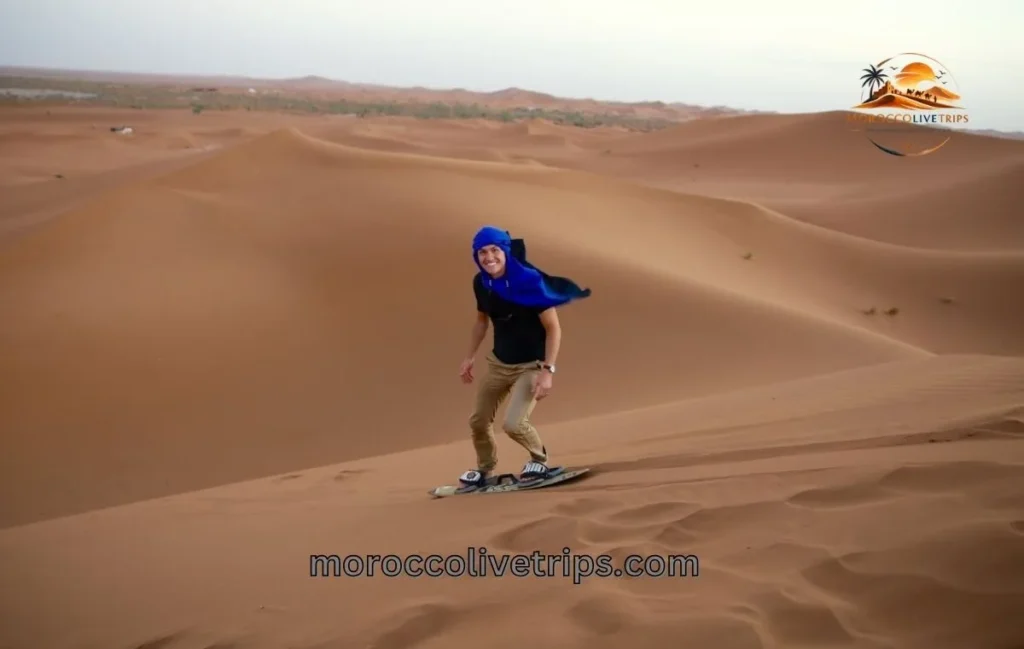
Erg Chebbi is the largest and tallest area of sand dunes in Morocco, stretching for more than 20 kilometres with dunes reaching around 150 metres high. The colour of the sand shifts from gold to deep orange and pink as the sun moves. Beyond the camel ride and camp, you can add sandboarding, a 4×4 excursion around the dunes, a visit to Khamlia for Gnawa music or a meal with a nomad family.
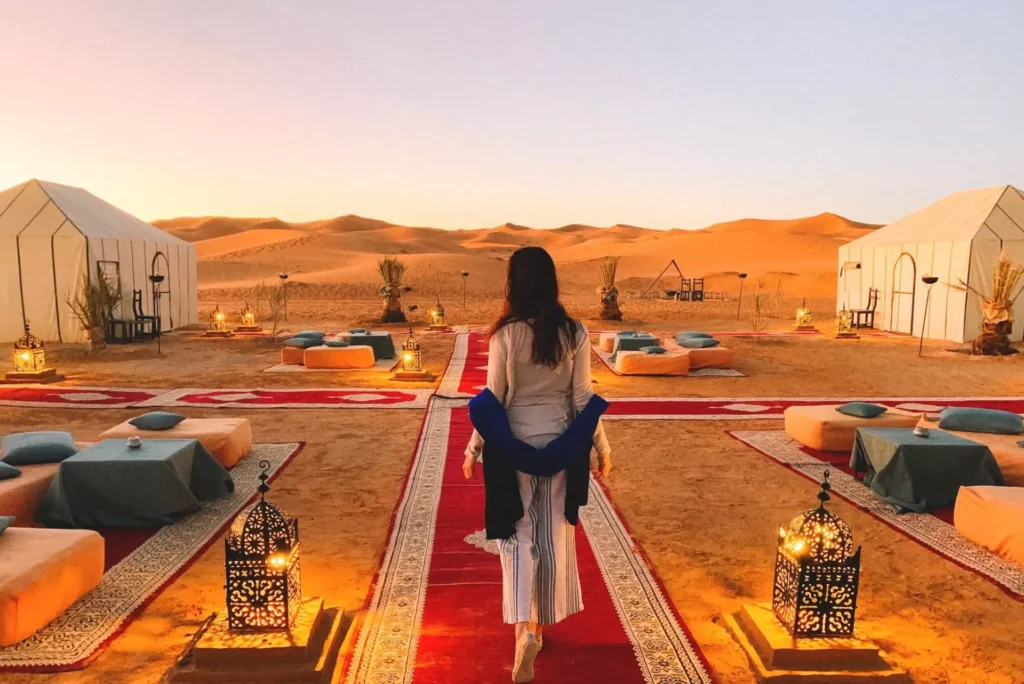
For most travellers, the night in the Sahara is the reason for the whole trip. After the camel ride you arrive at camp around dusk, usually in time to climb a dune and watch the last of the light. Dinner is typically a Moroccan feast of soup, salads and a tagine, followed by fruit and mint tea. In the evening the camp staff often play traditional drums around the fire, and then, away from any town lights, the stars appear in numbers most people have never seen before.
On a private tour you choose the level of camp that suits you:
Comfortable traditional tents with proper beds, blankets and shared or private facilities, depending on the camp. A good choice for travellers who want the authentic experience without paying for extra luxury.
Spacious tents with en-suite bathrooms, hot showers, quality bedding, electricity and a more refined dinner. Popular with couples, honeymooners and families who want comfort after a long day. Our guide to the luxury desert camps in Merzouga explains what to expect and how the camps differ.

Tip: take a small overnight bag to camp with what you need for one night: warm layers, toiletries, a head torch, phone charger or power bank and any medication. Your main luggage stays safely in the vehicle with your driver.
The traditional way to reach camp is by camel, a ride of roughly an hour to an hour and a half into the dunes. If anyone in your group would prefer not to ride, for example young children, travellers with back problems or anyone nervous of camels, the camp can usually be reached by 4×4 instead, and the rest of the group can still ride. You can read more about the experience in our guide to the overnight camel trek in the Erg Chebbi dunes.
Every quote we send lists exactly what is and isn’t included, so you can compare tours properly. On our standard private Marrakech to Merzouga tours, the following are normally included:
Usually not included, unless your quote says otherwise:
Your quote will confirm every item for your dates and camp choice. If something is important to you, such as a private bathroom at camp, a specific hotel or a vegetarian menu, tell us and we’ll include it in the plan.
We match the vehicle to your group. Couples and small groups usually travel in a comfortable 4×4 or saloon, while families and larger groups travel in a spacious minivan or a private minibus. All vehicles are air-conditioned and suited to mountain roads and long distances. Your driver-guide speaks English, knows the route intimately and can explain the history, culture and landscape as you go. If you’d like to know more about how our drivers work across Morocco, see our page on private Morocco tours with a driver.
Tell us your dates, group size and camp preference. Your quote will list exactly what’s included, with no surprises.
Because every private tour is built for one group, the price depends on a few clear factors. Rather than publish a single “from” price that rarely matches what you actually want, we send a precise quote for your dates. These are the things that change the price:
Our private tours are designed to be good value for the comfort and flexibility you get. For a fuller breakdown of the costs involved in desert travel, see our guide to Marrakech desert tours. If you’re planning something more upscale, our luxury Morocco tour packages combine the Sahara with boutique riads and private experiences.
You can travel from Marrakech to Merzouga all year, but the experience changes with the seasons:
Many travellers consider this the best season. Days are warm and pleasant in the desert, the Atlas valleys are green and the Rose Valley blooms in late April and May. It is also busy, so book early, especially around Easter.
The Sahara is very hot in summer, and daytime temperatures in Merzouga can exceed 40°C. Tours still run, but we plan the camel ride for late afternoon and keep the hottest hours for driving in an air-conditioned vehicle. Nights at camp are warm and pleasant.
Another excellent time. The heat eases, the light is soft and the date harvest is under way in the oases. October and November are among our busiest months.
Days in the desert are usually sunny and mild, but nights can be cold, sometimes near freezing, and the Tizi n’Tichka pass occasionally sees snow. Camps provide heavy blankets, and a luxury camp is especially welcome at this time of year. Bring warm layers and a hat.
For a month-by-month view, read our guide to the best time to visit the Sahara in Morocco.
A private vehicle lets you stop whenever children need a break, choose family rooms and adapt the camel ride to younger kids. Our Morocco family tours with a desert camp stay are built around exactly this route, and our luxury Morocco family holidays add more comfort.
A private tour is ideal for a romantic trip: a luxury camp with an en-suite tent, a candlelit dinner in the dunes and sunrise on your own dune, without a busload of other travellers.
Shorter driving days on a 4-day route, comfortable hotels and a 4×4 to camp instead of a camel make the desert accessible and enjoyable.
Time your stops for the best light, return to the dunes for golden hour and take as long as you need at Ait Ben Haddou and the gorges.
Share the cost of the vehicle and driver, travel together and plan the trip around what your group enjoys.
You don’t need special equipment for the desert, but a few things make the trip much more comfortable:
The Sahara fits easily into a longer private trip. Many travellers begin with a few days in Marrakech, perhaps with a sunrise hot air balloon flight over Marrakech, then cross to the desert and finish in Fes before heading to Chefchaouen. Others start in Casablanca or Tangier and include the desert in a 7- to 14-day circuit. Our luxury tour packages and private driver tours show how the pieces fit together, and we can plan the whole route for you.
“Everything was perfectly organized. The desert camp, camel ride, hotels and guides were amazing. Highly recommended!”Tripadvisor traveler
“One of the best trips we ever had. Friendly driver, beautiful landscapes and unforgettable memories.”Tripadvisor traveler
“Professional team and excellent communication from start to finish. The Sahara sunset was magical.”Tripadvisor traveler
Tell us your travel dates, the number of travellers, where you’re staying in Marrakech and whether you’d like to return to Marrakech or finish in Fes. Let us know your preferred camp (standard or luxury) and anything else that will help us plan.
Prefer to talk? WhatsApp or call +212 601-339154 or email moroccolivetrips@gmail.com.
The drive from Marrakech to Merzouga is roughly 550 to 560 kilometres and takes about nine to ten hours without stops. On a private tour we split the journey over two days on the way out, with stops at the Tizi n’Tichka pass, Ait Ben Haddou, the Dades Valley and the Todra Gorge, so you arrive in the dunes on the afternoon of day 2.
Three days is the minimum we recommend for most travellers: two days to reach the desert with proper sightseeing and one day to return. Four days is more relaxed and breaks up the long return drive. A 2-day tour is possible, but it means around nine to ten hours of driving each day with little time for stops.
On a private tour the vehicle and driver-guide are only for your group, and you decide the timing, the stops and the pace. Shared tours fill a minibus with other travellers and follow a fixed schedule. Private tours also let you choose your hotels and your desert camp, and start or end where you like.
Yes. We can collect you at Marrakech Menara Airport and start the tour the same day, or drop you there at the end. Let us know your flight times when you request a quote so we can plan the route around them.
Yes. Many travellers finish in Fes, which is closer to Merzouga than Marrakech. The final day crosses the Middle Atlas via Midelt and the cedar forests near Azrou and Ifrane, and you are dropped at your riad in Fes.
Our standard private tours include a private air-conditioned vehicle with fuel, an English-speaking driver-guide, pickup and drop-off at your accommodation, accommodation along the route with dinner and breakfast, the camel ride and a night in a desert camp with dinner and breakfast. Lunches, drinks, entrance fees, local guides and tips are usually not included. Your quote lists everything for your dates.
We match the vehicle to your group size: a comfortable 4×4 or car for couples and small groups, and a spacious minivan or private minibus for families and larger groups. All vehicles are air-conditioned and suited to mountain roads and long distances.
The camel ride is gentle and most people enjoy it, including children and older travellers. If anyone prefers not to ride, the camp can usually be reached by 4×4 while the rest of the group rides. Tell us in advance and we will arrange it.
You can choose a standard camp with comfortable traditional tents, or a luxury camp with en-suite tents, hot showers and better bedding. Both include dinner, breakfast and an evening around the fire, usually with traditional drumming, under the desert stars.
Luxury camps have private en-suite bathrooms with hot showers in each tent. Standard camps vary: some have private facilities and others have shared bathrooms. We’ll tell you exactly what your camp offers when we send your quote.
The price depends on the number of travellers, the number of days, the camp level, the hotels along the route, your start and end points and the season. Because every tour is private, we send a precise quote for your dates rather than a generic price. Request a free quote and you’ll usually hear back within 24 hours.
Spring (March to May) and autumn (September to November) are the most comfortable seasons, with warm days and pleasant nights. Summer is very hot in the desert, and winter nights can be cold, but tours run all year and each season has its own appeal.
The route is a well-travelled tourist road through towns and villages, and travelling with a private driver-guide who knows the area is one of the most comfortable ways to make the journey. As anywhere, take normal travel precautions and check your government’s latest travel advice before you go.
Yes. A second night in the Erg Chebbi area gives you a full day to explore the dunes, visit Khamlia for Gnawa music, try sandboarding or a 4×4 excursion, or simply relax at camp. Ask us to add it to your itinerary.
Pack layers for warm days and cool nights, sun protection, comfortable shoes, a small overnight bag for camp, a head torch, a power bank, any medication and some cash in dirhams. In winter, bring a warm jacket and a hat for the evening at camp.
Mobile signal is often available in and around Merzouga and at many camps, although it can be weak in the dunes. Some camps offer Wi-Fi, but it can be slow. It’s best to think of the night as a chance to switch off and enjoy the stars.
Yes. Because the tour is private, you can change almost anything: the number of days, the hotels, the camp, the stops along the way and the start and end points. Tell us what matters to you and we’ll design the itinerary around it.
Send us your dates and group details using the form on this page, by WhatsApp or by email. We’ll send an itinerary and price. Once you’re happy, a deposit confirms the booking and the balance is paid before the tour starts. Payment and cancellation terms are set out in writing in your quote.
Tell us your dates and we’ll plan a private tour from Marrakech to Merzouga around you, with your own driver, your choice of camp and a clear price, with no obligation.