
The Classic 8-Day Route
Rabat, Chefchaouen, Volubilis, a full day in Fes, the Sahara, Todra and Dades, Ait Ben Haddou and Marrakech, with a relaxed final morning.
See the day-by-day plan

Land in Casablanca, finish in Marrakech, and see the best of Morocco in between: the blue streets of Chefchaouen, the medina of Fes, a night under the stars in the Erg Chebbi dunes and the kasbahs of the south. Your own car, your own driver, your own pace.
Private Morocco tour · Casablanca → Sahara → Marrakech
A Casablanca to Marrakech tour via the desert is the most complete way to see Morocco in one trip. Instead of taking the direct motorway south, which covers the 240 km between the two cities in about three hours, you travel in a loop: north to Rabat and the Rif Mountains, east to Fes, over the Middle Atlas to the Sahara, then west along the Road of a Thousand Kasbahs and over the High Atlas into Marrakech. You start where most international flights land and finish in Morocco’s most popular city, without backtracking. Prefer the cities to the dunes? See our Morocco imperial cities tour.
At Morocco Live Trips we run this route as a private tour. That means a vehicle and driver for your group only, accommodation chosen to suit your budget, and an itinerary you shape before you travel. Most travellers take seven or eight days; we also plan a faster six-day version and a slower ten-day version with extra nights in Chefchaouen, Fes and Marrakech.
This page explains everything you need to decide: which itinerary length suits you, the full day-by-day route, realistic driving times, where you sleep in the desert, what is included, what affects the price and how booking works. If you already know what you want, request a free quote and we will send you a personalised plan.
Prefer to begin your trip somewhere else? See our private tour from Marrakech to Merzouga, or browse all our Morocco tour packages.
It is a multi-day road trip that starts in Casablanca and ends in Marrakech, with at least one night in the Sahara Desert at Merzouga. Because Merzouga lies in the far east of Morocco, close to the Algerian border, the route naturally passes through the imperial city of Fes on the way out and through the Dades Valley, Ouarzazate and Ait Ben Haddou on the way back. Most versions also add Rabat and Chefchaouen at the start.
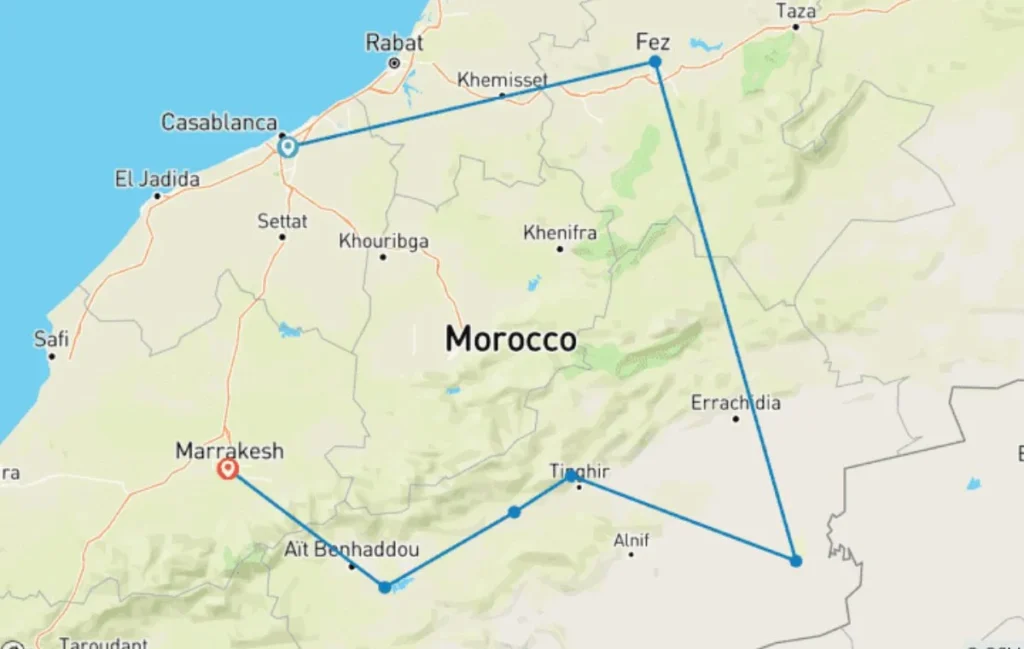
Quick answer: A private Casablanca to Marrakech tour via the Sahara usually takes 7 or 8 days (6 is the practical minimum). The typical route is Casablanca → Rabat → Chefchaouen → Fes → Ifrane and the Middle Atlas → Merzouga (night in an Erg Chebbi desert camp) → Todra Gorge → Dades Valley → Ait Ben Haddou → Marrakech. You cover roughly 1,500 km in total, with your own driver, and you can stop wherever you like.
If your only goal is to get from one city to the other, the direct motorway or the train is the answer. But very few travellers fly into Casablanca and want to skip the rest of the country. The desert route turns a three-hour transfer into a full journey through four UNESCO World Heritage Sites (Rabat, the Medina of Fes, Volubilis and Ait Ben Haddou), two mountain ranges and the dunes of Erg Chebbi. It is also an efficient shape for a trip: you fly into one city and out of another, so you never spend a day driving back the way you came.
It suits first-time visitors who want to see the highlights in one go, travellers arriving on transatlantic flights into Casablanca’s Mohammed V Airport, couples and families who prefer a private car to buses and trains, and anyone who wants the desert to be part of a bigger trip rather than a rushed excursion from Marrakech.
This is a long journey with some long driving days. Who you travel with, and how much control you have over the day, makes a bigger difference here than on a short excursion. A private tour gives you:
We have written a detailed comparison of a private driver vs a group tour in Morocco. In short: a group tour can cost less per person, but on a route this long, the freedom to set your own pace usually matters more.
| Private tour (Morocco Live Trips) | Typical shared group tour | |
|---|---|---|
| Who is in the vehicle | Only your family or group | Strangers, often 10–17 people |
| Start point | Casablanca airport, hotel or riad | Fixed meeting point and time |
| Itinerary | Built around you; changes are free before you book | Fixed; no detours |
| Photo and rest stops | Whenever you ask | Set stops only |
| Accommodation | Chosen with you, from riads to luxury hotels | Pre-set, usually budget |
| Desert camp | Standard or luxury, your choice | Usually a shared standard camp |
| Departure dates | Any day you choose | Set departure days |
Tell us your arrival date, how many days you have and how many people are travelling. We’ll send a private itinerary and a clear price, with no obligation.
The distance is the same whichever version you choose. What changes is how much time you spend in each place. Fewer days means longer drives and shorter visits; more days means a second night in the places you love. Here are the four versions travellers ask us for most.
Rabat, Chefchaouen, Volubilis, a full day in Fes, the Sahara, Todra and Dades, Ait Ben Haddou and Marrakech, with a relaxed final morning.
See the day-by-day plan
The same route as the classic tour, with Casablanca, Rabat and the drive to Chefchaouen combined on day 1. The best choice if you are short on time but want everything.
See the 7-day version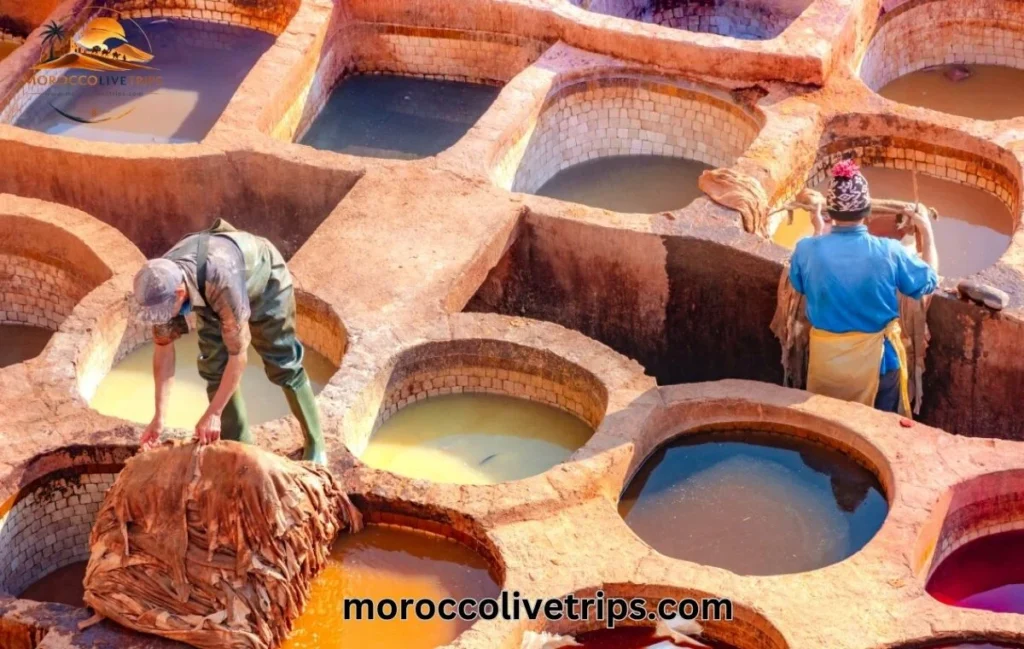
A full day in Chefchaouen, a guided day in Fes, a night in the Dades Valley and a full day to explore Marrakech before you fly home.
See the 10-day version
Skip Chefchaouen and go straight to Fes. Long driving days, but you still get the medina, the dunes and the kasbahs.
See the 6-day versionThe route forms a loop through the north, east and south of Morocco. The table below shows realistic driving times for each stage, excluding stops. Your actual day will be longer because you will stop for sightseeing, photos, lunch and coffee, and we plan for that.
| Stage | Approx. distance | Driving time (no stops) | Main stops |
|---|---|---|---|
| Casablanca → Rabat | 90 km | 1 hr – 1 hr 15 | Hassan II Mosque, Rabat Kasbah of the Udayas |
| Rabat → Chefchaouen | 250 km | 3 hr 30 – 4 hr | Rif Mountain views |
| Chefchaouen → Fes (via Volubilis) | 260 km | 4 hr – 4 hr 30 | Volubilis Roman ruins, Meknes |
| Fes → Merzouga | 470 km | 7 – 8 hr | Ifrane, cedar forest, Midelt, Ziz Valley |
| Merzouga → Dades Valley | 290 km | 4 hr 30 – 5 hr | Rissani, Todra Gorge, Tinghir |
| Dades Valley → Marrakech | 310 km | 5 hr 30 – 6 hr | Ouarzazate, Ait Ben Haddou, Tizi n’Tichka pass |
The longest stage is Fes to Merzouga. It is a beautiful drive, through Ifrane (known as the “Switzerland of Morocco”), the cedar forests of the Middle Atlas where Barbary macaques live, and down the palm-filled Ziz Valley. But it is a full day. Breaking it with a night in Midelt is possible on the 10-day version, and we recommend it for travellers who find long car journeys tiring.
Good to know: the Tizi n’Tichka pass on the final day climbs to about 2,260 m. The road is paved and well maintained, but it is winding. If you are prone to car sickness, tell us in advance and your driver will plan extra stops on the mountain section.
This is our most requested version. It gives you a full day in Fes and keeps the long driving days manageable. For the fixed product page with photos of each stop, see our 8-day tour from Casablanca to the desert via Chefchaouen and Fes.
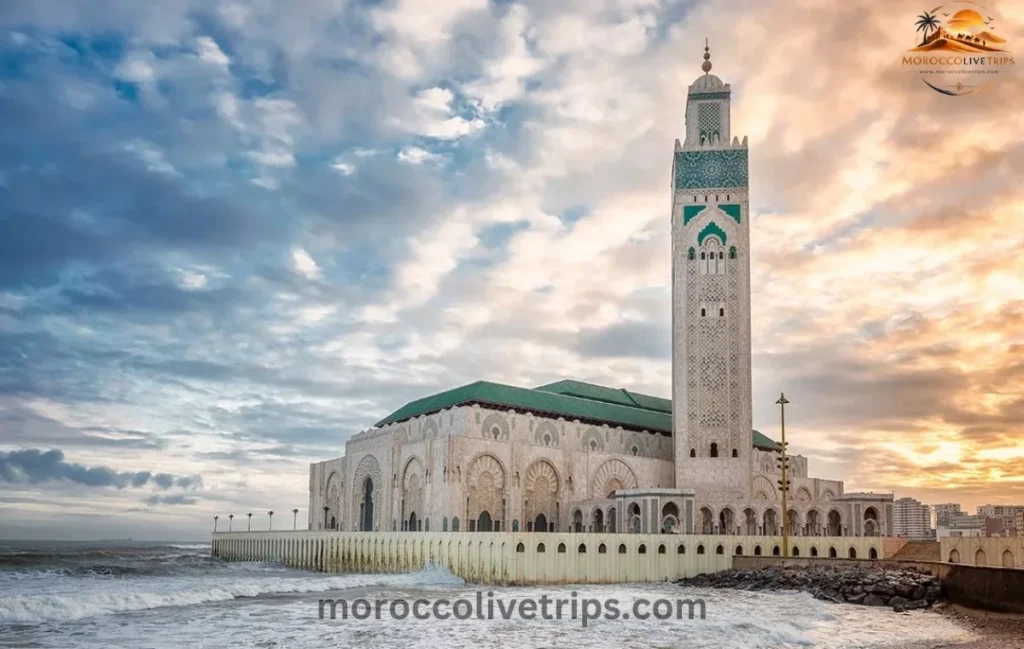
Your driver meets you at Mohammed V International Airport (or your hotel or the port) and takes you into the city. If your flight lands in the morning, you can visit the Hassan II Mosque the same day. It is one of the largest mosques in the world and one of the very few in Morocco that non-Muslim visitors can enter, on guided tours that run at set times. Its minaret rises over the Atlantic, and the craftsmanship inside, from carved cedar ceilings to zellige tilework, is extraordinary.
Afterwards, walk along the Corniche or visit the Habous quarter, a 1930s “new medina” with bookshops and pastry shops. Overnight in Casablanca. For more ideas, see our guide to things to do in Casablanca.
After breakfast, drive one hour up the coast to Rabat, Morocco’s capital. Visit the Hassan Tower and the Mausoleum of Mohammed V, then walk through the white-and-blue lanes of the Kasbah of the Udayas, which looks over the mouth of the Bou Regreg river. Rabat’s modern capital and historic city are a UNESCO World Heritage Site.
From Rabat the road heads inland and climbs into the Rif Mountains. You arrive in Chefchaouen in the late afternoon, in time to watch the light fade over the blue medina from the Spanish Mosque viewpoint. Overnight in Chefchaouen.
Spend the morning in Chefchaouen while the streets are quiet. This is the best time for photographs. Late morning, drive south to Volubilis, the best-preserved Roman site in Morocco and a UNESCO World Heritage Site, famous for its mosaics and triumphal arch. If time allows, stop briefly in Meknes to see the monumental Bab Mansour gate. Arrive in Fes in the early evening. Overnight in a riad in Fes.
Today is a full day in Fes, with a licensed local guide for the medina. Fes el-Bali is one of the largest car-free urban areas in the world, with around 9,000 lanes. You will see the Bou Inania Madrasa, the Al-Attarine Madrasa, the outside of the Al Quaraouiyine mosque and university, and the Chouara tannery, where leather is still dyed in stone vats. In the afternoon, your driver can take you to the Royal Palace gates, the Jewish quarter (the Mellah) and a panoramic viewpoint over the city. Overnight in Fes. Our Fes medina guided tour tips will help you plan the day.
This is the longest day, and one of the most spectacular. Leave Fes after breakfast and climb into the Middle Atlas. Stop in Ifrane, a tidy alpine-style town, then in the cedar forest near Azrou, where Barbary macaques often come close to the road. Lunch is usually in Midelt, below the snow-capped Jebel Ayachi.
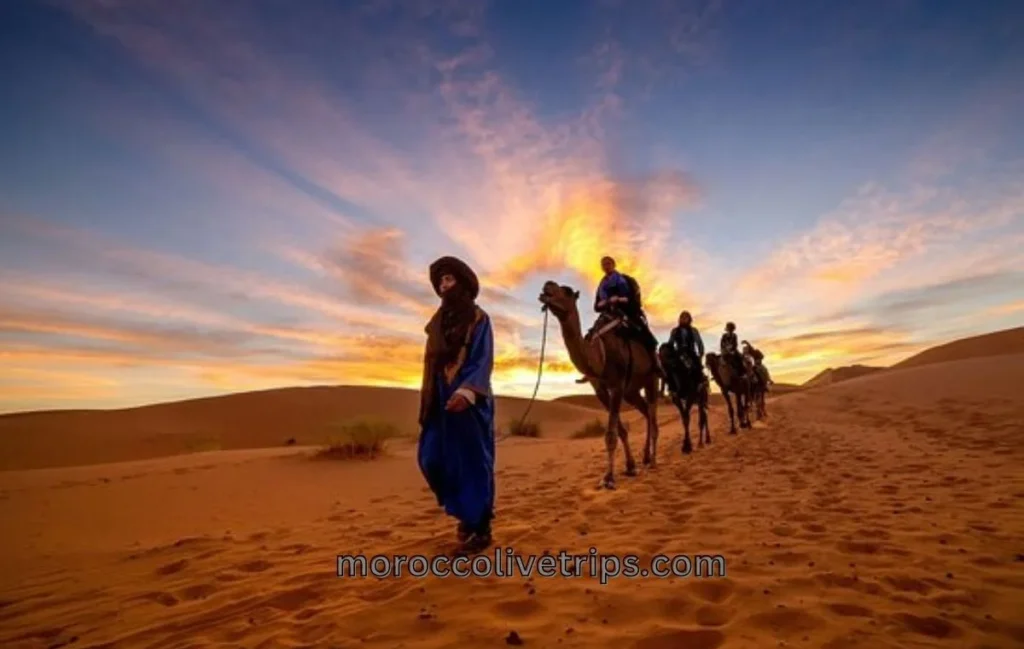
In the afternoon you descend through the Ziz Gorges and the Ziz Valley, a long green ribbon of date palms, past Errachidia and Erfoud. Near Merzouga you leave the vehicle and ride a camel into the Erg Chebbi dunes as the sun sets, or travel to camp by 4×4 if you prefer. Dinner, music around the fire and a night under one of the darkest skies in Morocco. Overnight in a desert camp.
Wake early to watch the sun rise over the dunes, then ride back to Merzouga for breakfast and a shower. Drive west through Rissani, the historic market town of the Tafilalt oasis, and on to Tinghir. Walk into the Todra Gorge, where limestone walls rise around 300 m above a clear stream. Continue to the Dades Valley, known for its winding road and red rock formations. Overnight in a kasbah hotel in the Dades Valley.
Follow the Road of a Thousand Kasbahs through the Valley of Roses (famous for its rose festival each May) and Skoura’s palm grove to Ouarzazate. A short detour brings you to Ait Ben Haddou, the fortified mud-brick village (ksar) that is a UNESCO World Heritage Site and has appeared in many films. Cross the river and climb to the granary at the top for the view.
After lunch, cross the High Atlas over the Tizi n’Tichka pass and descend into Marrakech in the early evening. Your driver drops you at your riad or hotel. Overnight in Marrakech.
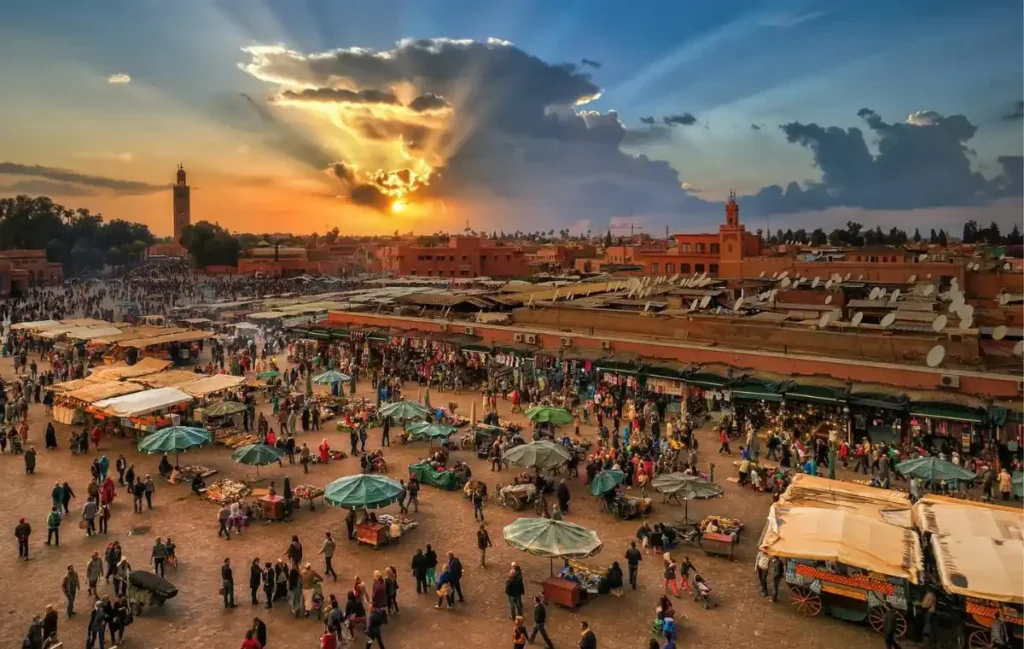
Depending on your flight time, use the morning to explore Marrakech: Jemaa el-Fnaa square, the Koutoubia Mosque, the Bahia Palace or the Majorelle Garden. We can arrange a local city guide. Your driver will take you to Marrakech Menara Airport when it is time to go. If you would rather fly home from Casablanca, we can drive you back there instead (about three hours by motorway).

The 8-day plan suits most people, but the route is flexible. These are the variations we plan most often. Each is private, and each can be adjusted further.
The 7-day version follows the same path but removes the separate full day in Fes. Instead, Casablanca, Rabat and the drive to Chefchaouen are combined on day 1 (best if you land early), so you reach Fes on day 2 and have day 3 for a guided medina tour before leaving for the Sahara. It works well for travellers who have one week and want all the main highlights. See the full plan on our 7-day tour from Casablanca page.
Ten days lets you travel without rushing. You get a full day to wander Chefchaouen, a guided day in Fes plus a free afternoon, an optional overnight in Midelt to split the long drive to the desert, and a full day in Marrakech at the end. Some travellers use the extra time for a second night in the Sahara instead. See our 10-day Morocco tour from Casablanca, or read our 10-day itinerary guide from Casablanca for more detail on each stop.
If you only have six days, we drive straight from Casablanca to Fes on day 1 (about three and a half hours), skipping Rabat and Chefchaouen. You get a guided morning in Fes, then follow the same route through the desert and the south to Marrakech. It is a full trip, but there is less time to relax. We only recommend it if you are comfortable with several long days in the car.
You can extend the tour at either end. Popular additions include a night in Essaouira on the Atlantic coast after Marrakech, a sunrise hot air balloon flight over Marrakech, a second night in the dunes with sandboarding and a 4×4 trip around Erg Chebbi, or a stop at the Roman ruins with a longer Volubilis visit. If you would like something completely different, our tailor-made Morocco tours start from a blank page.
Yes. Many travellers fly into Marrakech and out of Casablanca, and we run the loop in either direction. The days are the same in reverse. Just tell us which airport you arrive at and which you leave from.
This route links some of Morocco’s most important places. Here is what makes each stop worth your time, so you can decide where to add an extra night.
Morocco’s largest city and economic centre is best known for the Hassan II Mosque, completed in 1993, which stands partly over the ocean and has a minaret more than 200 metres tall. Casablanca also has some of the finest Art Deco and Mauresque architecture in Africa, especially around Boulevard Mohammed V and the Central Market. One night here is usually enough. Read more in our Casablanca travel guide.
The capital is calm, green and easy to explore. The Kasbah of the Udayas, the Hassan Tower and the unfinished 12th-century mosque beside it, and the marble Mausoleum of Mohammed V are the main sights. Rabat is a good place to ease into Morocco before the busier medinas.
The “Blue Pearl” of the Rif Mountains is famous for its blue-washed walls, stairways and doors. It is smaller and more relaxed than Fes or Marrakech, and many travellers say it is their favourite stop. Our Chefchaouen guide covers the best viewpoints and when to visit.
Volubilis was an important town on the edge of the Roman Empire. Today its columns, arches and floor mosaics stand in open countryside below the Zerhoun hills. Nearby Meknes, one of Morocco’s four imperial cities, is known for the vast walls and gates built by Sultan Moulay Ismail in the 17th century.
Fes is Morocco’s spiritual and cultural capital and the oldest of its imperial cities. Its medina, Fes el-Bali, is a UNESCO World Heritage Site and feels much as it did centuries ago, with donkeys carrying goods through narrow lanes, craftsmen working copper and wood, and the famous tanneries. A local guide makes a huge difference here; it is very easy to get lost.
The drive south from Fes passes through Ifrane, built in a European alpine style, and the cedar forests around Azrou. These forests are home to the Barbary macaque, Morocco’s only wild monkey, which you can often see near the roadside. In winter, this area can be covered in snow.
Between Midelt and Erfoud, the road follows the Ziz river through a dramatic gorge and then a long valley of date palms and earth-built villages. The viewpoint over the palm grove is one of the best photo stops of the trip.
Erg Chebbi is Morocco’s best-known sea of sand dunes, with some dunes reaching around 150 metres high. The village of Merzouga sits at its edge. This is where you ride camels at sunset, sleep in a desert camp and watch the sun rise over the sand. Find out more in our Merzouga guide.
The Todra Gorge is a narrow canyon near Tinghir with sheer rock walls on both sides. The Dades Valley, a little further west, is known for its zigzag road, rock formations and kasbahs. Both are good places to stretch your legs after the desert.
Ouarzazate is the gateway to the Sahara and home to large film studios. Ait Ben Haddou, 30 minutes away, is a ksar of earthen houses on a hillside and a UNESCO World Heritage Site. It is one of the most photographed places in Morocco.
The tour ends in Marrakech, the “Red City”, with its lively Jemaa el-Fnaa square, souks, palaces and gardens. If you can, stay at least one or two extra nights here at the end of your trip.
The night in the Erg Chebbi dunes is the emotional centre of this trip. Every private tour includes a desert camp, and you choose the level of comfort. Both options include the camel ride, dinner, breakfast, and the chance to see sunset and sunrise over the dunes.
| Standard desert camp | Luxury desert camp | |
|---|---|---|
| Tent | Traditional Berber tent with beds and blankets | Larger private tent with proper beds and decor |
| Bathroom | Usually shared facilities at the camp | Private en-suite bathroom with shower and toilet |
| Dinner | Moroccan dinner (tagine, soup, fruit) | Multi-course dinner, often with more choice |
| Atmosphere | Simple, authentic, campfire and drums | Comfortable, quieter, more space between tents |
| Best for | Travellers who want the experience over comfort | Couples, families, seniors and special occasions |
| Price | Included in the base tour | Supplement added to your quote |
If the desert night is the highlight of your trip, we suggest the luxury option. A private bathroom and a real bed make a big difference after a long drive from Fes. See our full guide to the luxury desert camps in Merzouga, or, if you want the camp itself to be the centrepiece, our 5-star desert camp Merzouga private tour.

Most travellers ride a camel to camp, which takes around 60–90 minutes depending on the camp’s location. If you have mobility problems, are travelling with young children or simply prefer not to ride, we can arrange a 4×4 transfer to the camp instead, subject to the camp’s access. You can still take a short camel ride at sunset.
After you arrive, there is time to climb a dune for the last light. Dinner is served in a dining tent or outside, followed by Berber music around the fire. Away from towns, the sky is very dark, and on clear nights the stars and the Milky Way are spectacular. In the morning you wake before dawn to watch the sunrise, then return to Merzouga for breakfast and to continue the tour.

You travel in a modern air-conditioned vehicle sized for your group, such as a Toyota Land Cruiser 4×4 for smaller groups or a Mercedes Vito minivan for families and larger groups, subject to availability. The vehicle is for your use only for the whole tour, so you can leave bags in it while you explore. Child seats are available on request.

Your driver is Moroccan, speaks English and knows this route well. Along the way they explain what you are seeing, help with ordering food, and suggest places to stop. For the guided medina visit in Fes (and in Marrakech, if you add a city tour), we arrange a licensed local guide, who can take you deeper into the old city than a driver can.
We book accommodation to match your style and budget, and every hotel is confirmed in your quote before you pay anything. Typical choices are:
Prefer luxury throughout? Our luxury Morocco tour packages use boutique riads, upscale hotels and luxury camps on this same route.
Your quote lists exactly what is included, so there are no surprises. As a guide, a standard private Casablanca to Marrakech desert tour includes:
Meals and entrance fees can be added to your package if you prefer to pay one price up front. Just ask when you request your quote.
Because every private tour is planned around the traveller, there is no single price. We send a clear, itemised quote for your dates and group. The main factors that affect the price are:
The best way to know your price is to ask for a free quote. Tell us your budget and we will tell you honestly what is possible.
Send us your dates, group size and preferred trip length. We will reply with a personalised day-by-day plan and a clear price.
The tour runs all year, but conditions change a lot between the coast, the mountains and the desert. Spring and autumn are the most comfortable seasons on this route.
| Season | Months | What to expect |
|---|---|---|
| Spring | March – May | Warm days, green valleys, roses in the Dades Valley in May. Ideal overall, but popular, so book early. |
| Summer | June – August | Pleasant on the coast and in Chefchaouen, but very hot in Fes, Marrakech and the Sahara, often above 40°C. We plan early starts and rest in the afternoon. |
| Autumn | September – November | Warm, settled weather and clear desert nights. One of the best times to go. |
| Winter | December – February | Mild, sunny days but cold nights, close to freezing in the desert. Snow is possible in the Middle Atlas and on the Tizi n’Tichka pass. |
If you are travelling during Ramadan, the tour runs as normal. Some cafés and restaurants close during the day, and your driver will help you find places to eat. Read more in our guide to the best time to visit the Sahara in Morocco.
You will pass through cities, mountains and desert, so pack layers. You only need to bring a small overnight bag to the desert camp; your main luggage stays safely in the vehicle.
The Casablanca to Marrakech route works for most travellers because the private format can be adjusted. Here is how we plan it for different groups:
Mohammed V International Airport (CMN) is about 30 km south of central Casablanca. The drive into the city takes about 40 minutes, longer in rush hour. Your driver will wait in the arrivals hall with a name sign and will track your flight, so delays are not a problem. You can withdraw dirhams from ATMs at the airport, and buy a local SIM card in the arrivals area if you want mobile data on the road. If you land late at night, we usually recommend staying near the city centre rather than starting the drive straight away.
We are a Morocco-focused tour company that plans only private trips. Our team lives in Morocco and drives these roads regularly, so we can give you honest advice about driving times, the right number of days and which camp suits you. Learn more about our local Morocco tour company, or read our guide on how to choose a Morocco tour operator.
“Everything was perfectly organized. The desert camp, camel ride, hotels and guides were amazing. Highly recommended!”Tripadvisor traveler
“One of the best trips we ever had. Friendly driver, beautiful landscapes and unforgettable memories.”Tripadvisor traveler
“Professional team and excellent communication from start to finish. The Sahara sunset was magical.”Tripadvisor traveler
Tell us your arrival date in Casablanca, your departure airport, the number of travellers and how many days you have. Let us know your preferred accommodation level and camp (standard or luxury), and anything else that will help us plan.
Prefer to talk? WhatsApp or call +212 601-339154 or email moroccolivetrips@gmail.com. You can also reach us through our contact page.
Seven or eight days is ideal. Six days is the practical minimum and means long driving days. Ten days lets you add extra nights in Chefchaouen, Fes and Marrakech and break the drive to the desert.
The usual route is Casablanca, Rabat, Chefchaouen, Volubilis, Fes, Ifrane and the Middle Atlas, the Ziz Valley, Merzouga (Erg Chebbi), the Todra Gorge, the Dades Valley, Ouarzazate, Ait Ben Haddou, the Tizi n’Tichka pass and Marrakech. It is about 1,500 km in total.
About 470 km, or seven to eight hours of driving without stops. With lunch and photo stops it is a full day. On longer itineraries, you can split it with a night in Midelt.
It is 100% private. The vehicle and driver are for your group only, and we do not run shared group tours.
It starts with pickup at Casablanca’s Mohammed V Airport, your hotel or the port, and ends with drop-off at your riad, hotel or Marrakech Menara Airport. We can also return you to Casablanca if you are flying home from there.
Yes. The route works in both directions and the days are the same in reverse. Tell us your arrival and departure airports and we will plan it accordingly.
Standard itineraries include one night in an Erg Chebbi desert camp. You can add a second night for more time in the dunes, sandboarding or a 4×4 tour around the area.
No. Most travellers ride a camel to camp, but we can arrange a 4×4 transfer instead for anyone who prefers not to ride, subject to the camp’s access.
You choose between a standard camp with traditional tents and a luxury camp with private en-suite tents. The name of the camp is confirmed in your quote.
A modern air-conditioned vehicle sized for your group, such as a Toyota Land Cruiser 4×4 or a Mercedes Vito minivan, subject to availability. It is used only by your group.
Yes. Our drivers speak English and know the route well. For the guided medina visit in Fes, we arrange a licensed local guide.
Private vehicle and fuel, driver, accommodation, the desert camp night, the camel ride, breakfasts and the dinners listed in your itinerary, and a local guide in Fes. Flights, lunches, drinks, entrance fees, tips and optional activities are usually extra. Your quote lists everything.
The price depends on the number of days, group size, accommodation level, camp choice and season. We send a free, itemised quote for your exact dates.
Yes. We add more stops, shorter driving blocks, child seats and a 4×4 to the camp where needed. The 10-day version is the most relaxed for families and seniors.
Yes. The mosque is open to non-Muslim visitors on guided tours at set times, with an entrance fee. We plan your arrival day or the morning of day 2 around the tour times. Visitors should dress modestly.
Spring (March to May) and autumn (September to November) are the best. Summer is very hot inland and in the desert, and winter brings cold desert nights and possible snow in the mountains.
The roads on this route are paved and widely used by tourists. Travelling with an experienced local driver who knows the roads, the weather and the rest stops is one of the most comfortable ways to cover the distance.
Request a quote through our form, WhatsApp or email. Once you are happy with the itinerary, a deposit confirms the booking. The balance and cancellation terms are set out in your quote and our booking terms.
Tell us when you arrive in Casablanca and how many days you have. We’ll plan a private tour via the desert around you, with your own driver, your choice of camp and a clear price, with no obligation.