A Morocco desert tour from Marrakech takes you from the Red City across the High Atlas Mountains to the dunes of the Sahara, usually finishing in Merzouga or Zagora depending on how many days you have. Most travelers do it in 2 to 4 days, though the same route can be extended into a full 7 or 10 day loop through Morocco’s imperial cities. It’s the single most booked trip out of Marrakech, and for good reason. Nowhere else in North Africa puts a UNESCO kasbah, a 2,260 meter mountain pass, a palm lined river valley, and a genuine Saharan dune field within reach of a long weekend.
This page walks through the actual route, the real differences between a Merzouga tour and a Zagora tour, what a private tour costs versus a shared one, and what to expect once you’re standing at the edge of Erg Chebbi at sunset. Morocco Live Trips runs these trips as a Marrakech based operator. Our guides drive this road regularly, not occasionally, so the information below reflects how the trip actually works, not how it looks in a brochure. If you already know which tour you want, you can request a custom itinerary or message us directly on WhatsApp. If you’re still comparing options, keep reading.
What Is a Morocco Desert Tour from Marrakech?
A Morocco desert tour from Marrakech is a guided road trip, usually by private 4×4 or minivan, that travels south from Marrakech over the High Atlas Mountains to the Sahara Desert and back. The most common endpoint is Merzouga, home to the Erg Chebbi dune field, though shorter and mid length tours often end instead at Zagora or the more remote Erg Chigaga dunes. The tour includes overnight stops, a camel trek into the dunes, and at least one night sleeping in a desert camp.
These trips are not day tours in the way a city tour is. The Sahara itself sits roughly 560 km from Marrakech by road, and getting there is genuinely part of the experience, not a formality to skip through. That distance is exactly why the tour length matters so much when you’re choosing between two, three, four, or more days, and why each option is broken down separately below rather than presented as interchangeable.
How Far Is the Sahara Desert from Marrakech?
The nearest real Sahara dunes to Marrakech are at Erg Chebbi, near Merzouga, roughly 560 kilometers away, about 8 to 9 hours of driving one way, broken into two days rather than done in one push. The Zagora route to the smaller dunes near M’Hamid and Erg Chigaga is somewhat shorter, at around 360 to 450 km depending on the exact endpoint, and can realistically be reached in a single long day, though most operators still split it over two.
Neither route is a straight highway drive. Both cross the Tizi n’Tichka pass through the High Atlas Mountains, which slows the journey considerably compared to flat terrain, and both are far more enjoyable split across two days with stops than rushed in one. This is the main reason a 1-day “desert tour” from Marrakech almost always means the Agafay Desert, a rocky, semi arid landscape about 30 minutes from the city that resembles the Sahara in photos but isn’t the same ecosystem, the same dunes, or the same experience. If your goal is to stand on actual Saharan sand dunes, budget at minimum two days, and ideally three or four.
Agafay Desert vs the Sahara: Why the Distinction Matters
Because “desert tour from Marrakech” gets used loosely, it’s worth separating the two destinations clearly before you book anything. Agafay is a stony, semi arid plateau close enough to Marrakech to visit as a half day or evening trip. It offers camel rides, quad biking, and increasingly, dinner shows at desert style camps, and it’s a genuinely good option if you have an afternoon free and don’t want to commit two or more days to the Sahara proper.
The Sahara itself, at Merzouga, Zagora, or Erg Chigaga, is a different landscape entirely: taller dunes, a longer journey, and an overnight camp far from any town. If a tour is marketed as a “1-day Sahara desert tour,” it is almost certainly an Agafay trip using Sahara as a loose descriptor. Neither option is better in absolute terms. They simply answer different questions: how much time do you have, and how far are you willing to travel for the experience.
Choosing Your Desert Tour: 2, 3, 4 Days or Longer
The right length depends on how much of the real Sahara experience you want versus how much time you have. Here’s how the main options compare.
| Tour Length | Main Destination | Nights in Desert | Best For |
|---|---|---|---|
| 2 Days | Zagora / Erg Chigaga area | 1 | Travelers short on time who still want a genuine dune night |
| 3 Days | Merzouga (Erg Chebbi) | 1 | The most popular option, covering the full classic route with one desert night |
| 4 Days | Merzouga (Erg Chebbi) | 2 | Couples and photographers who want two sunrises, plus more time in Dades Valley |
| 7 Days | Merzouga + Fes | 1 to 2 | Travelers combining the desert with Morocco’s imperial cities |
| 10 Days | Full Morocco circuit | 1 to 2 | First time visitors who want the whole country in one trip |
For exact current pricing on any of these, factors like group size, season, and camp category all affect the final quote. See the pricing section further down, or check availability and get a same-day quote here.
2-Day Marrakech Desert Tour (Zagora Route)
A 2-day desert tour from Marrakech is the shortest option that still includes a genuine overnight in the Sahara. The route runs south through the Draa Valley, Morocco’s longest river valley, lined with palm groves and old ksour (fortified villages), toward Zagora and the dunes near M’Hamid or Erg Chigaga. You’ll ride camels into the dunes in the late afternoon, watch the sunset, sleep in a Berber camp, and drive back to Marrakech the next day after a short sunrise walk.
This route is genuinely worth it if two days is all you have, but it’s worth being honest about the trade-off. You’ll spend a large share of your two days in the vehicle, and you’ll see one sunset and one sunrise rather than the fuller route through Ait Ben Haddou and the gorges that the 3 and 4 day tours include. It’s the right call for travelers on a tight schedule, not for anyone hoping to also see Ouarzazate or Todra Gorge. You can view the 2-day Zagora desert tour itinerary here.
3-Day Marrakech to Merzouga Desert Tour
This is the tour most people mean when they search for a Morocco desert tour from Marrakech, and it’s the best balance of time, distance, and experience for most travelers.
Day 1 covers the drive over the Tizi n’Tichka pass, at 2,260 meters the highest paved road in North Africa, with a stop at Ait Ben Haddou, the UNESCO listed kasbah used as a filming location for Gladiator and Game of Thrones. The night is spent in Ouarzazate, sometimes called the “Hollywood of Morocco” for its film studios.
Day 2 continues through the Dades Valley and Todra Gorge, where limestone walls rise up to 300 meters on either side of a narrow road, before arriving in Merzouga in the afternoon. From there, it’s a camel trek into Erg Chebbi to watch the sunset, dinner at a desert camp with live Gnawa music, and a night under skies with essentially zero light pollution.
Day 3 starts before dawn with a second camel trek to watch the sunrise turn the dunes from grey to gold, then the drive back to Marrakech, arriving in the evening.
It’s a full itinerary, and the two travel days are long. This isn’t a relaxed pace, but it’s the version of the trip that covers the most ground and the most landmarks for the time invested. Full details on the 3-day Marrakech to Merzouga desert tour are here.
4-Day Marrakech Desert Tour (Two Nights in the Desert)
The 4-day version follows the same route as the 3-day tour but adds a second night in the desert and more breathing room around the Dades Valley. Practically, this means two sunsets and two sunrises over the dunes instead of one, more time to actually rest in camp rather than treating it as a single overnight stop, and a less rushed pace on the two long driving days.
Most travelers who’ve done both the 3 and 4 day versions say the extra day is worth it, particularly for couples and photographers. One sunrise over Erg Chebbi is memorable, but the second one, once you already know the terrain, is usually the better photo session. See the full 4-day desert tour itinerary for the day by day breakdown.
Longer Private Tours: 7 and 10 Days from Marrakech
If the desert is only part of what you want from Morocco, the 7-day and 10-day tours fold the same Sahara route into a bigger loop that also covers Fes, Chefchaouen, Casablanca, and the Atlas Mountains.
The 7-day tour from Marrakech runs Marrakech to Ait Ben Haddou to Merzouga to Fes and back to Marrakech, covering Morocco’s two most important historic cities plus the Sahara in one week. The 10-day tour from Marrakech extends further to include Casablanca, Rabat, Chefchaouen, Meknes, and Volubilis, effectively covering the entire country in one connected trip. Both are run as private tours, so the pace and stops can be adjusted around what you actually want to see.
Merzouga vs Zagora vs Erg Chigaga: Which Desert Should You Choose?
This is one of the most common questions before booking, and there isn’t a single correct answer. The right destination depends on your timeline and what you want from the desert.
| Merzouga (Erg Chebbi) | Zagora / M’Hamid | Erg Chigaga | |
|---|---|---|---|
| Distance from Marrakech | About 560 km | About 360 to 450 km | About 450 to 500 km, plus a 4×4 or camel transfer |
| Dune height | Tall and dramatic, up to 150m | Smaller, more scattered dunes | Tall and remote, Morocco’s largest dune sea |
| Minimum realistic tour length | 3 days | 2 days | 3 to 4 days |
| Access | Paved road most of the way | Paved road most of the way | Final stretch requires 4×4 or camel |
| Crowds | Busiest desert gateway in Morocco | Quieter than Merzouga | Very quiet, remote |
| Best suited to | First time desert visitors, most travelers | Time limited travelers wanting a genuine dune night | Travelers wanting solitude, willing to spend an extra day getting there |
Merzouga is the classic choice, and for good reason. Erg Chebbi has the tallest, most photogenic dunes within realistic driving distance of Marrakech, the camp infrastructure is the most developed, and it’s the destination most 3 and 4 day tours are built around.
Zagora works well when time is the limiting factor. The dunes are smaller and the setting less dramatic than Erg Chebbi, but the drive is shorter, so a genuine overnight desert experience becomes possible in two days instead of three.
Erg Chigaga is the choice for travelers who’ve already done a desert tour before, or who specifically want to get away from the more visited camps near Merzouga. It requires more time and usually a 4×4 transfer or camel trek for the final stretch, since it isn’t reachable directly by paved road, but the payoff is a genuinely quiet, remote dune field. Our Chigaga desert tours run as a 3-day itinerary and a 4-day itinerary built specifically around this route.
If you’re unsure which fits your trip, this is exactly the kind of decision worth asking us about directly rather than guessing. We can match the destination to your dates and interests rather than the other way around.
Private vs Shared Desert Tours from Marrakech
The other major decision, independent of which desert you choose, is whether to book a private tour or join a shared group tour.
| Private Tour | Shared / Group Tour | |
|---|---|---|
| Departure time | Flexible, built around you | Fixed schedule |
| Vehicle | Just your group | Shared with other travelers |
| Stops | Fully customizable | Fixed itinerary, set stops |
| Pace | As fast or slow as you want | Set for the group |
| Photography time | Unlimited at each stop | Limited, group paced |
| Good for | Couples, families, small groups, photographers | Solo travelers wanting to meet others |
| Cost | Higher per person for solo travelers, more efficient for groups | Generally lower per person |
A private tour means the vehicle, the driver, and the schedule are yours. If you want an extra 20 minutes at Ait Ben Haddou, want to stop for a photo the itinerary didn’t plan for, or are traveling with kids or older family members who need a slower pace, this is the version that accommodates that. All of our desert tours run as private trips by default. See what that looks like on our About page, which also means the itinerary itself can be adjusted before you even leave, whether that’s adding a night, changing the route, or upgrading the camp.
A shared tour puts you with other travelers in one vehicle, following a fixed schedule. It’s a reasonable option for solo travelers who want the social element of meeting people along the way, and it’s typically the lower cost option since the vehicle and guide costs are split. The trade-off is a fixed pace: if the group wants to leave a stop early or linger longer than you’d like, you don’t have much say in it.
Neither is objectively better. A solo backpacker and a family celebrating an anniversary have genuinely different priorities here.
The Route South: Key Stops Between Marrakech and the Sahara
Whichever tour length you choose, most Merzouga bound routes pass through the same core landmarks. Understanding what each one actually is makes the long driving days feel less like transit and more like part of the trip.
Tizi n’Tichka Pass and the High Atlas Mountains
The road out of Marrakech climbs almost immediately into the High Atlas Mountains, crossing the Tizi n’Tichka pass at 2,260 meters, the highest paved mountain pass in North Africa. The road winds through Berber villages, past almond and walnut groves depending on the season, with views back toward the Marrakech plain on a clear day. It’s a slow stretch of driving by design. This isn’t a road built for speed, and rushing it would mean missing the reason it’s included in the itinerary at all.
Ait Ben Haddou
Ait Ben Haddou is a fortified ksar, a cluster of earthen kasbahs built from rammed clay, and a UNESCO World Heritage Site since 1987. It’s one of the best preserved examples of traditional pre-Saharan architecture in Morocco, and it’s been used as a filming location for productions including Gladiator, Lawrence of Arabia, and Game of Thrones. Most tours stop for an hour or two to walk through the ksar itself, which sits across a riverbed from the newer town.
Ouarzazate
Ouarzazate is the overnight stop on most 3-day-plus itineraries, and it’s worth more than a passing mention. It’s home to Morocco’s major film studios (the reason it’s nicknamed the “Hollywood of Morocco”), the Taourirt Kasbah, and it sits at a natural crossroads between the Atlas Mountains and the routes toward both Zagora and Merzouga.
Dades Valley and Todra Gorge
Between Ouarzazate and Merzouga, the road passes through the Dades Valley, often called the Valley of a Thousand Kasbahs for the density of old fortified structures along the river, and Todra Gorge, where limestone canyon walls rise up to 300 meters on either side of a narrow road and an even narrower river. Both are common photo and short walk stops on 3 and 4 day itineraries.
Draa Valley (Zagora Route)
Travelers heading toward Zagora instead of Merzouga follow the Draa Valley, Morocco’s longest river valley, lined with palm groves, fortified ksour, and small farming villages. It’s a greener, slower landscape than the Dades route, and it’s part of what makes the shorter Zagora tour feel less like a straight transit run despite covering less distance overall.
Life in the Desert Camp: Camels, Dunes, and Sahara Nights
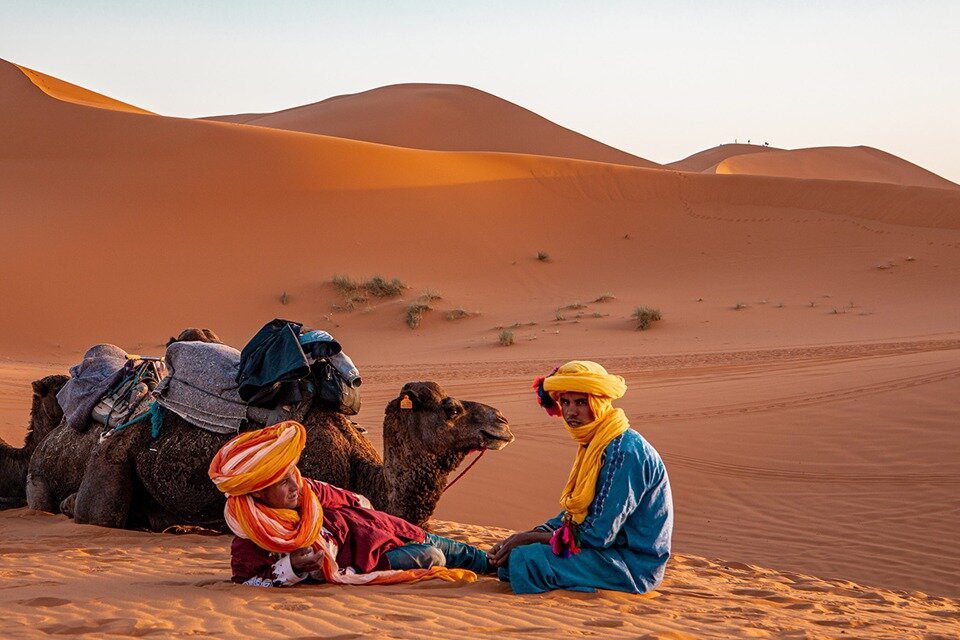
The desert portion of the tour follows a fairly consistent structure regardless of which dune field you end up at. In the late afternoon, you transfer from the vehicle to camels for the trek into the dunes, typically 45 minutes to an hour, timed to arrive before sunset. Vehicles generally can’t, and shouldn’t, drive directly into the dune fields, which is part of why the camel trek is the only way in for most camps.
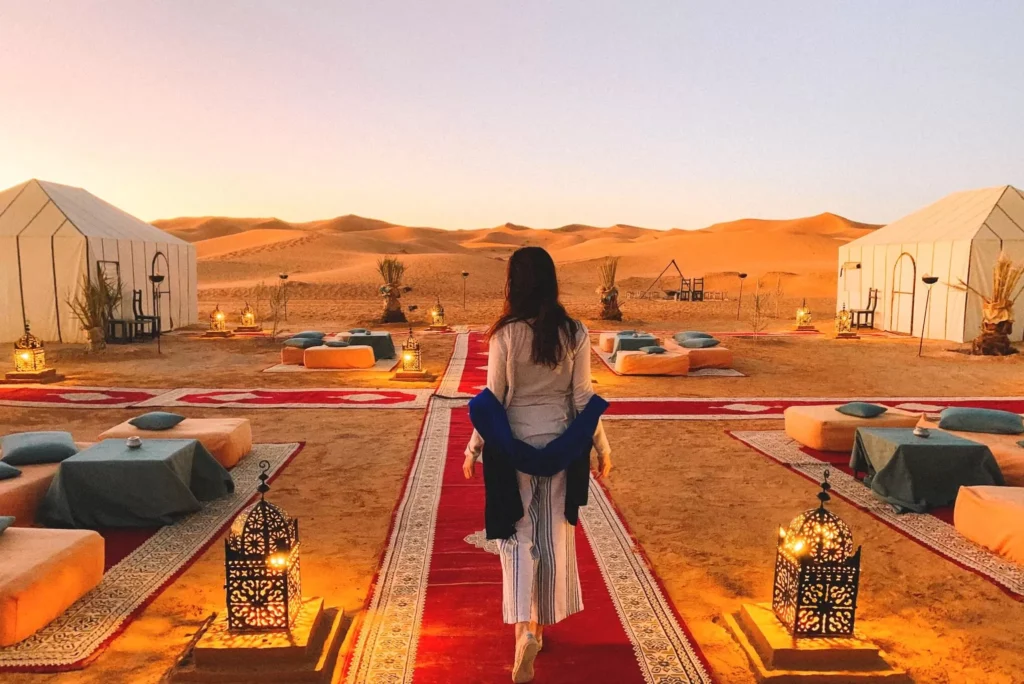
Camp itself is a cluster of tents, ranging from simple shared-bathroom setups to private tents with attached bathrooms depending on the camp category you book. Dinner is typically a tagine cooked over a fire, often followed by Gnawa or Berber drumming around the fire, genuinely local rather than staged specifically for tourists, though obviously shaped by decades of hosting travelers. Because Sahara camps sit far from any town, light pollution is essentially zero, and clear nights offer some of the best stargazing available anywhere in Morocco.
The next morning starts before sunrise for a second camel trek, or a short walk if you’d rather skip the ride back, to watch the dunes shift from grey to gold as the sun comes up. It’s the moment most of the marketing photography for these tours comes from, and it earns the reputation.
What’s Included in a Morocco Desert Tour from Marrakech?
Inclusions vary slightly by exact package, but a standard multi-day desert tour with Morocco Live Trips includes:
- Private transport in an air conditioned vehicle
- A licensed driver-guide for the full route
- Accommodation each night (hotel or riad on driving days, desert camp on the Sahara night)
- Breakfast daily and most dinners
- The camel trek into and out of the dunes
- Park and site entrance fees along the route
- 24/7 support during your trip
Typically not included: international or domestic flights, lunches (so you can choose where to stop), personal spending, tips for your driver-guide, and travel insurance. If you’re comparing quotes between operators, this is exactly the list worth checking line by line, since “desert tour” packages vary considerably in what they actually cover.
What Affects the Price of a Morocco Desert Tour?
Desert tour pricing depends on several variables, and it’s worth understanding them before requesting a quote so the number you get back makes sense.
- Number of travelers: private tours are priced per group or per person depending on group size, and larger groups typically bring the per person cost down
- Tour length: a 2-day Zagora tour and a 10-day full circuit tour are obviously priced very differently
- Camp category: standard shared-bathroom camps cost less than private luxury camps with en-suite tents
- Vehicle type: a standard sedan or minivan versus a 4×4 (needed for some Erg Chigaga routes)
- Private vs shared: private tours cost more per person for solo travelers, since you’re not splitting the vehicle and guide cost
- Season: spring and autumn, the most popular travel months, can carry different rates than the quieter summer or winter months
- Add-ons: quad biking, hot air balloon rides, extra nights, or route customizations
Because these variables shift the total so much, we don’t publish a single fixed number here. The accurate way to get a real price is to tell us your dates, group size, and preferences and get a same-day quote by email or WhatsApp, with the full cost confirmed before you book.
Best Time for a Morocco Desert Tour from Marrakech
Spring (March to May) and autumn (September to November) are the best times for a Morocco desert tour, with daytime temperatures typically between 18°C and 28°C, comfortable for both the mountain crossing and the desert stretch. Summer (June to August) regularly pushes past 40°C in the Sahara during the day, which doesn’t make the trip impossible but does make midday stops considerably less pleasant. Winter is mild during the day but genuinely cold at night in the desert, often dropping close to freezing, so a winter desert camp requires warmer layers than most travelers expect from “Morocco” and “desert” in the same sentence.
Who Takes a Morocco Desert Tour from Marrakech?
Couples tend to gravitate toward the 4-day private option: two nights in the desert, a slower pace, and the option to upgrade to a private luxury camp for an anniversary or honeymoon trip.
Families with children generally do well on the 3-day Merzouga route or a shorter Agafay based desert day trip if the kids are young, since the two long driving days on the full Merzouga route are a real consideration with small children. Private tours make it easier to build in extra stops and bathroom breaks along the way.
Solo travelers often choose a shared tour specifically for the social element, though a private tour remains entirely possible solo. It simply costs more per person since there’s no group to split the vehicle with.
Seniors can do any of these tours, but the camel trek and camp terrain (loose sand, no paved paths) are worth planning around. Private tours make it far easier to adjust pace, skip a camel trek in favor of a 4×4 transfer if preferred, and build in rest stops on the long driving days.
What to Pack for a Morocco Desert Tour?
- Layers: daytime desert heat and nighttime desert cold can differ by 20°C or more, especially outside summer
- A scarf or shemagh for sand and sun protection during the camel trek
- Closed shoes for the camp and dunes, plus sandals for camp downtime
- Sunscreen and sunglasses, since the desert sun is stronger than it looks
- A basic first aid kit and any personal medication
- A power bank, since camps generally run on generator or solar power with limited outlets
- Cash in Moroccan Dirham (MAD), since camps and small towns along the route are largely cash based
How to Book: What Actually Happens After You Get in Touch?
Booking a desert tour from Marrakech is generally a short back and forth rather than an instant checkout, and knowing what to expect makes the process faster on your end too.
- You send your travel dates, approximate group size, and which desert (Merzouga, Zagora, or Chigaga) interests you, along with any must-see stops.
- We reply, usually within 24 hours, with a proposed itinerary and a price based on your specifics rather than a generic listed rate.
- You review it, request any changes (extra nights, upgraded camp, added stops), and we adjust and reconfirm.
- Once confirmed, you’ll receive booking terms and payment details, along with a point of contact for the trip itself.
- Your driver-guide meets you at the agreed pickup point on day one, and 24/7 WhatsApp support runs for the length of the trip.
This process is roughly the same whether you’re booking a 2-day Zagora trip or a full 10-day circuit. The main variable is how much detail goes into step one and two, since a fully custom multi-stop itinerary naturally takes a little longer to finalize than a standard 3-day Merzouga route.
Booking Your Morocco Desert Tour from Marrakech
Morocco Live Trips is a Marrakech based operator, not an international agency managing the trip remotely. Tours are led by Moha BN, a Moroccan born, licensed tour guide with over 10 years of experience running private itineraries across Morocco, from the Marrakech medina to the Sahara. All tours are private by default and fully customizable: routes, nights, and camp category can all be adjusted around what you actually want.
Reviews and trip verification are available on our TripAdvisor profile rather than only on-site testimonials, so you can check them independently before booking.
To book: message us on WhatsApp, email moroccolivetrips@gmail.com, or fill out the contact form with your dates, group size, and preferred desert destination. We typically respond within 24 hours with a customized itinerary and pricing. Full payment and cancellation terms are outlined here before you commit.
If you’re still deciding between Merzouga, Zagora, and Chigaga, or between a 3-day and 4-day route, that’s exactly the kind of question worth asking before booking rather than after. Get in touch and we’ll help you match the right tour to your trip.
FAQ: Morocco Desert Tours from Marrakech
How long does a Morocco desert tour from Marrakech take?
Most desert tours from Marrakech run 2 to 4 days. A 2-day tour reaches the Zagora/Erg Chigaga area, while 3 and 4-day tours reach Merzouga’s Erg Chebbi dunes, which are further away but have taller, more dramatic dunes.
How far is the Sahara Desert from Marrakech?
The Erg Chebbi dunes near Merzouga are about 560 km from Marrakech, roughly 8 to 9 hours of driving split across two days. The Zagora route is shorter, at around 360 to 450 km.
Is Merzouga or Zagora better for a desert tour?
Merzouga has taller, more photogenic dunes and is the better choice if you have 3 or more days. Zagora is the better choice if you only have 2 days but still want a genuine overnight desert experience.
Is a 2-day desert tour from Marrakech worth it?
Yes, if time is limited. It includes a real overnight in the desert near Zagora. It won’t include the Ait Ben Haddou and Todra Gorge stops that longer Merzouga tours cover.
Is 3 days enough for a Morocco desert tour?
For most travelers, yes. Three days covers the full route to Merzouga including Ait Ben Haddou, Ouarzazate, and one night in the desert, though it involves two fairly long driving days.
What is included in a Marrakech desert tour?
Typically private transport, a licensed driver-guide, accommodation, breakfast and most dinners, the camel trek, entrance fees, and 24/7 support. Flights, most lunches, tips, and travel insurance are usually not included. Always confirm the specific inclusions before booking.
Can I book a private desert tour from Marrakech?
Yes. Private tours are the default option and can be fully customized on route, pace, and camp category, for solo travelers, couples, families, or small groups.
Can desert tours from Marrakech be customized?
Yes. Nights, stops, camp type, and the exact route can be adjusted before departure to fit your dates and interests.
What is a Sahara desert camp actually like?
Tents range from simple shared-bathroom setups to private en-suite tents depending on the camp category. Camps typically include a fire cooked dinner, live Berber or Gnawa music, and stargazing with minimal light pollution.
Is camel trekking included in desert tours?
Yes, the camel trek into and out of the dunes is a standard part of Merzouga, Zagora, and Chigaga desert tours.
Can families with children do a Morocco desert tour?
Yes, though the long driving days are worth planning around for young children. Private tours make it easier to add breaks and adjust pace.
Can I visit Ait Ben Haddou and the Sahara on the same tour?
Yes. Ait Ben Haddou is a standard stop on the route to Merzouga and is included on 3-day, 4-day, and longer itineraries.
What is the difference between the Agafay Desert and the Sahara?
Agafay is a rocky, semi arid area about 30 minutes from Marrakech, suitable for a half day or evening trip. The Sahara, at Merzouga, Zagora, or Erg Chigaga, has genuine sand dunes and requires at least 2 days to reach and experience properly.
What is the best time of year for a Sahara desert tour from Marrakech?
Spring (March to May) and autumn (September to November), with daytime temperatures between 18°C and 28°C. Summer is very hot in the desert; winter nights in camp can be near freezing.
What should I pack for a Morocco desert tour?
Layers for the day and night temperature swing, closed shoes, a scarf for the camel trek, sunscreen, a power bank, and cash in Moroccan Dirham for camps and small towns.
How much does a Morocco desert tour from Marrakech cost?
Pricing depends on group size, tour length, camp category, vehicle type, and season, so it varies by itinerary. Contact us with your dates and preferences for an accurate quote.
Is it safe to do a desert tour in Morocco?
Morocco is generally considered one of the safer countries in Africa for tourism, and licensed driver-guides, vetted accommodation, and 24/7 support are standard on organized private tours.
How do I book a Morocco desert tour from Marrakech?
Message us on WhatsApp, email, or fill out the contact form with your dates and group size. Most operators, including Morocco Live Trips, respond within 24 hours with a customized itinerary and quote.
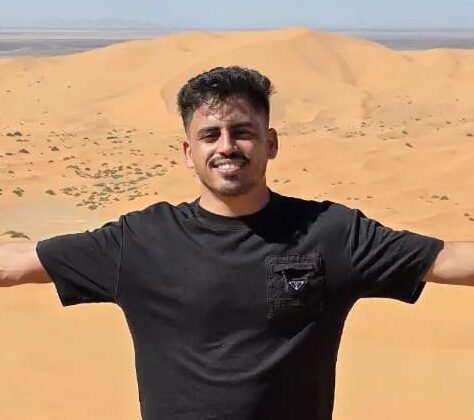
Moha BN is a Moroccan-born licensed tour guide with 10+ years of experience organizing cultural tours, Sahara Desert trips, and private itineraries across Morocco. He shares local travel insights, safety advice, and budget tips through Morocco Live Trips.