
An Ourika Valley day trip from Marrakech takes you 60 kilometres south of the city into the High Atlas Mountains – through traditional Berber villages, past olive groves and riverside markets, all the way to the Setti Fatma waterfalls at the end of the valley road. The whole experience fits comfortably into one day, with pickup from your Marrakech riad in the morning and return by early evening. Morocco Live Trips runs this as a private guided day tour – your own vehicle, your own guide, your own pace. No shared minibuses, no fixed group schedules, no rushing. If you want to book it directly, contact us today. If you want to know exactly what the day involves before you do, everything is covered below.
Why Choose an Ourika Valley Day Trip?
Marrakech is extraordinary, but after two days in the medina most visitors start craving space, fresh air, and a change of scenery. The Ourika Valley delivers all three – and it does it in a way that feels completely different from anything the city offers, without requiring a long journey to get there.
The valley sits just one hour from Marrakech, which means you lose almost no travel time getting there and back. What you gain is a full day in one of Morocco’s most beautiful natural landscapes – river valleys, mountain villages, cascading waterfalls, and the kind of clean cool air that the Marrakech medina simply cannot offer. It is the perfect single-day escape that almost every visitor to Marrakech benefits from building into their trip.
Morocco Live Trips has been running Ourika Valley tours for years, and it remains one of our most consistently loved experiences – particularly for families, couples, and first-time Morocco visitors who want to see the country beyond the city walls.
Where Is Ourika Valley?
The Ourika Valley sits in the Al Haouz Province, approximately 60 kilometres south of Marrakech in the foothills of the High Atlas Mountains. The valley follows the course of the Ourika River as it descends from the high mountain peaks, cutting a lush green corridor through the otherwise arid Atlas foothills.
The road into the valley climbs gradually from the Marrakech plain, passing through small market towns before entering the mountain landscape proper. By the time you reach Setti Fatma – the village at the far end of the valley road – you are at around 1,500 metres elevation, the air is noticeably cooler and cleaner, and the scenery around you looks nothing like the flat red city you left an hour ago.
The contrast between Marrakech and the Ourika Valley is part of what makes the day trip so satisfying. They are genuinely different worlds separated by sixty kilometres of road.
Top Attractions You Will Visit
High Atlas Mountain Scenic Drive
The journey into the valley is itself part of the experience. The road from Marrakech climbs steadily through the Atlas foothills, passing through villages of red mud-brick houses, roadside stalls selling pottery and local produce, and panoramic views across the plain behind you that get wider and more impressive with every kilometre.
The mountain scenery builds gradually as you drive deeper into the valley – rocky ridges giving way to greener slopes, the river appearing and disappearing beside the road, and traditional Berber villages clinging to the hillsides above the valley floor. Morocco Live Trips drivers know every good stopping point along this road for photographs, and they stop at all of them.
>>Want More Details about Atlas Mountains…
Explore Traditional Berber Villages
The Berber villages of the Ourika Valley are home to Amazigh families who have lived in these mountains for generations, farming small terraced plots of land and producing olive oil, argan products, and traditional crafts. Stopping in one of these villages with a local guide gives you a completely different perspective on Moroccan life than the medinas of Marrakech or Fes can offer.
A traditional Berber house visit – where you are welcomed with mint tea and shown the layout of a family home built into the hillside – is one of the most genuine cultural moments available on a day trip from Marrakech. Your Morocco Live Trips guide handles the introductions and translates, turning what could be an awkward tourist moment into a warm and natural exchange.
Visit an Argan Oil Cooperative
The Ourika Valley road passes several argan oil cooperatives – women-run production facilities where local Amazigh women crack open argan nuts by hand, grind the kernels on traditional stone mills, and produce the pure argan oil that Morocco is famous for worldwide. Stopping at a genuine cooperative – not a tourist shop dressed up as one – gives you the chance to watch the process, understand how labour-intensive it is, and buy directly from the women who produced it.
Morocco Live Trips only stops at verified cooperatives that genuinely support local women’s employment. The difference between a real cooperative and a roadside tourist trap is immediately apparent once you know what to look for, and your guide will make sure you are seeing the real thing.
Hike to the Setti Fatma Waterfalls
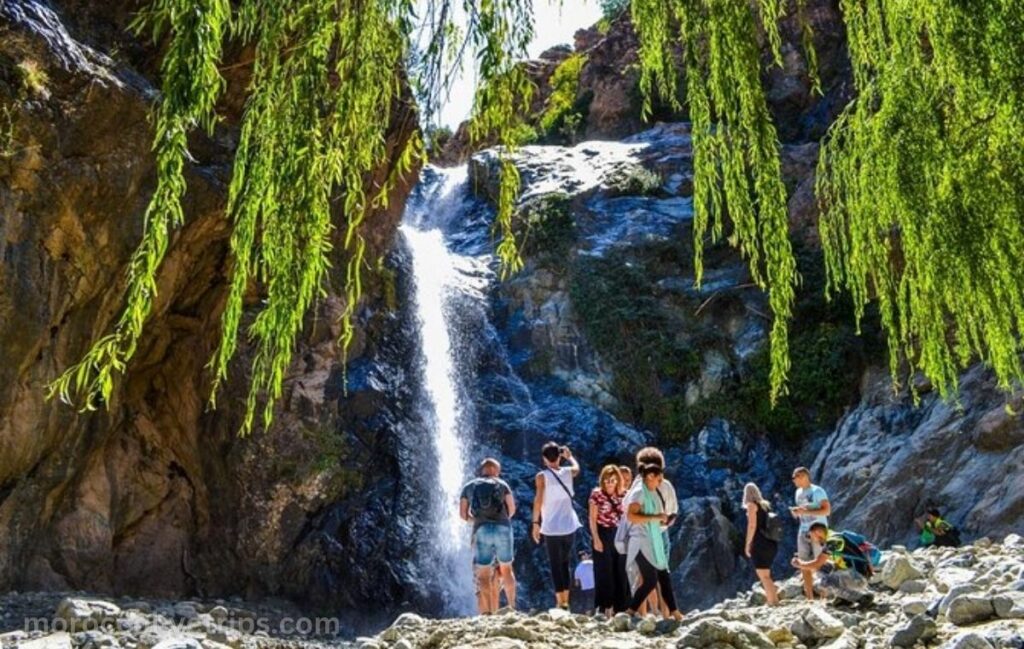
Setti Fatma is the village at the top of the valley road and the starting point for the most popular hike in the Ourika Valley. From the village, a trail follows the river upstream through a rocky gorge to a series of cascading waterfalls – the famous Seven Waterfalls of Setti Fatma – tucked into a narrow canyon above the village.
The hike to the first and most impressive waterfall takes approximately 20 to 30 minutes on a well-worn path that involves some rocky scrambling and river crossings on stepping stones. Local guides from the village offer their services at the trailhead, which Morocco Live Trips recommends accepting – they know the safest route and the best viewpoints, and their fee is modest. The higher waterfalls require more time and a reasonable level of fitness – reaching all seven takes two to three hours return and involves steeper terrain.
The waterfall itself, when you reach it, is genuinely worth the effort. Cold, clear water drops into a deep pool surrounded by smooth canyon walls, and the microclimate at the base of the falls is noticeably cooler and more lush than anywhere else on the valley trail.
Lunch by the Ourika River
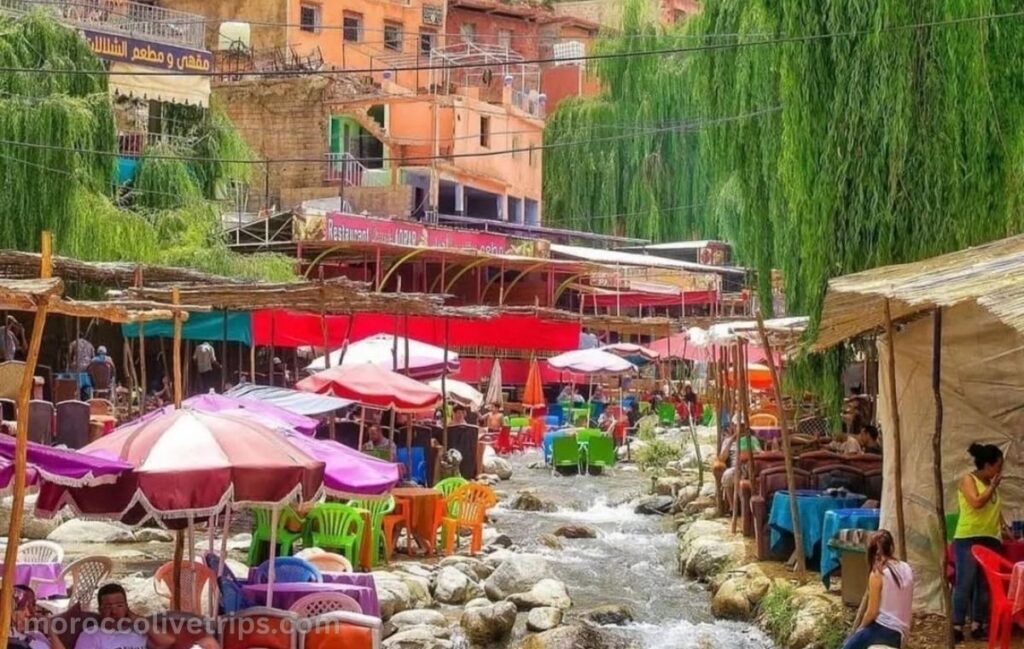
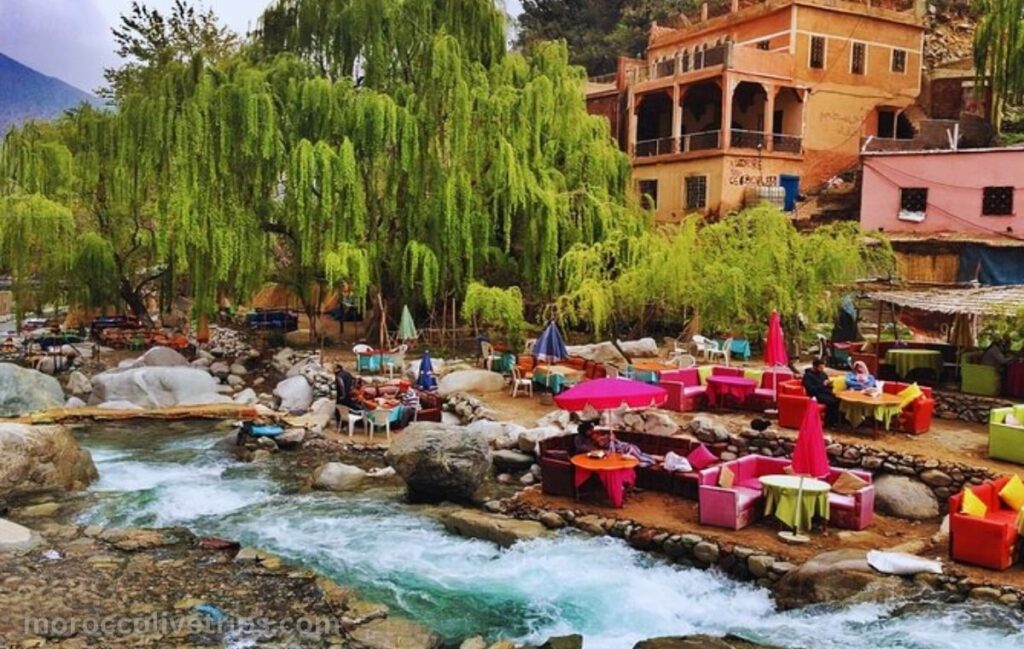
The Ourika River runs through the valley floor, and dozens of riverside restaurants have built their terraces directly over the water – tables set on wooden platforms above the rushing river, with mountain views in every direction and the sound of the water running below you. Lunch here, with a plate of Moroccan salads and fresh tagine, is one of the simple pleasures that makes the Ourika Valley day trip feel complete.
Morocco Live Trips recommends specific riverside restaurants that consistently deliver on food quality and freshness. Lunch is not included in the standard tour price but is easy to arrange, and your guide will recommend the right place based on your group’s preferences.
Detailed Ourika Valley Day Trip Itinerary
Here is exactly how a full day Ourika Valley tour with Morocco Live Trips runs from start to finish:
8:00am – Pickup from your Marrakech riad or hotel. Your private driver and guide collect you from your accommodation in a comfortable air-conditioned vehicle.
8:00am to 9:30am – Scenic drive into the valley. The road climbs gradually from the Marrakech plain into the Atlas foothills, with stops for photographs at the best viewpoints along the way. Your guide points out the landscape features, the villages, and the agricultural terracing as the valley opens up around you.
9:30am – Berber village visit. Stop at a traditional Amazigh village for a guided walk through the lanes and a mint tea welcome at a local home. Your guide explains the history, architecture, and daily life of mountain Berber communities.
10:30am – Argan oil cooperative. Visit a genuine women-run cooperative to watch the traditional argan oil production process and purchase directly from the producers if you wish.
11:30am – Setti Fatma and the waterfall hike. Arrive at Setti Fatma village and begin the hike to the waterfalls. Your Morocco Live Trips guide accompanies you on the trail, with the option to hire a local waterfall guide at the trailhead for the higher falls.
1:30pm – Riverside lunch. Return from the hike and settle at a riverside restaurant terrace for a proper Moroccan lunch with mountain views.
3:00pm – Explore the valley market (Monday visits). If your tour falls on a Monday, the weekly Tnine Ourika market is one of the most authentic rural markets in the Marrakech region – locals from across the valley come to buy and sell produce, livestock, and crafts in a gathering that has barely changed in generations.
4:00pm – Return drive to Marrakech. Arrive back at your accommodation by early evening, with the rest of your Marrakech night free.
What Is Included and What Is Not?
What Is Included
- ✅ Private air-conditioned vehicle throughout the day
- ✅ Professional English-speaking local guide
- ✅ Hotel or riad pickup and drop-off in Marrakech
- ✅ Scenic drive through the High Atlas Mountains
- ✅ Traditional Berber village visit with mint tea welcome
- ✅ Argan oil cooperative visit
- ✅ Guided hike to Setti Fatma waterfalls
- ✅ All local transport and parking fees
- ✅ Bottled water in the vehicle throughout the day
What Is Not Included
- ❌ Lunch (budget £8–£15 per person at riverside restaurant)
- ❌ Local waterfall guide fee at Setti Fatma (approx £3–£5 per group)
- ❌ Entrance fees to any paid attractions
- ❌ Personal purchases at argan cooperative or market
- ❌ Gratuities for guide and driver (appreciated but optional)
- ❌ Travel insurance
- ❌ International flights and airport transfers
Private vs Shared Ourika Valley Tours
This is a question Morocco Live Trips receives regularly, and the honest answer is straightforward – the right choice depends on your travel style and budget.
Shared tours join you with other travellers in a minibus – typically 8 to 15 people – following a fixed schedule with fixed stops. They cost less per person, usually between £20 and £35, and they are a perfectly reasonable way to see the valley if you are flexible about timing and comfortable sharing the experience with strangers. The trade-off is that you stop where the group stops and leave when the driver decides.
Private tours give you complete flexibility – your own vehicle, your own guide, your own pace. You stop longer at the places that interest you, skip the stops that do not, adjust the lunch timing to suit your group, and have a guide whose attention is entirely focused on your experience rather than divided across fifteen people. Morocco Live Trips runs exclusively private tours, which means every Ourika Valley day trip we arrange is built entirely around the group taking it.
For families with young children, couples, and travellers on their first visit to Morocco, the private experience makes a significant difference to how the day feels and what you get out of it.
Best Time to Visit Ourika Valley
Spring (March to May) is the best time for an Ourika Valley day trip. The valley is at its most lush and green after winter rainfall, the waterfalls are flowing strongly, the temperatures are comfortable at all elevations, and the wildflowers along the riverbanks are in full bloom. This is when the valley looks its most beautiful and the hiking is most enjoyable.
Autumn (September to November) is the second-best season – warm days, cooler mountain air, lighter tourist numbers than spring, and clear skies that make the Atlas Mountain scenery particularly sharp and dramatic.
Winter (December to February) is surprisingly good for valley visits. The waterfalls are at their most powerful, the air is exceptionally clear, and the high peaks visible from the valley are snow-capped in a way that makes the scenery extraordinary. Pack warm layers – it is noticeably cold in the mountains even on sunny winter days.
Summer (June to August) brings Marrakech residents to the valley in large numbers every weekend, as the valley’s cooler temperatures and river access make it a natural escape from the city heat. Weekday visits are manageable, but summer weekends at Setti Fatma can be genuinely crowded. If you are visiting in summer, a weekday tour is strongly recommended.
What to Bring
The Ourika Valley day trip covers several different environments – city, valley road, mountain village, river gorge, and waterfall trail – so packing practically makes the day significantly more comfortable.
Footwear is the most important consideration. The waterfall hike involves rocky terrain, river crossings on stepping stones, and uneven paths that are wet in places. Proper walking shoes or light hiking boots make a real difference. Flip-flops and city shoes are manageable for the valley floor but make the waterfall trail difficult and slippery.
Clothing layers matter more than most visitors expect. Marrakech in summer can be 38°C, but Setti Fatma at 1,500 metres elevation with river mist at the waterfall base can feel significantly cooler. A light jacket or long-sleeved layer that packs into a daypack is always worth bringing.
Sun protection – high-factor sunscreen, sunglasses, and a hat – is essential for the exposed parts of the waterfall hike and the open valley sections.
A small daypack to carry water, layers, a camera, and any purchases from the cooperative or market. Morocco Live Trips provides water in the vehicle throughout the day.
Cash in Moroccan dirhams for lunch, the local waterfall guide, market purchases, and tips. Card payment is not available at riverside restaurants, market stalls, or the waterfall trailhead.
>>Learn More on Morocco wearing guide…
Ourika Valley Day Trip Cost
Shared group tour: approximately £20 to £35 per person depending on the operator and what is included. Usually 8 to 15 people per vehicle, fixed itinerary, shared guide.
Private tour with Morocco Live Trips: priced per vehicle rather than per person, which means the per-person cost decreases as your group size increases. A private day tour for two people costs more per person than a shared tour. A private tour for four to six people is competitive with shared tour pricing and significantly better in experience quality.
Contact Morocco Live Trips directly for a personalised quote based on your group size, travel dates, and any specific inclusions or adjustments you want built into the day.
Travel Tips Before You Go
Monday is the best day to visit if your Marrakech schedule allows it. The weekly Tnine Ourika market runs every Monday morning and is one of the most authentic rural markets within easy reach of the city. Combining the market with the valley and waterfall hike in a single day gives you an exceptionally full and varied Ourika Valley experience.
Start early. A 8am departure gets you into the valley before the tour buses from the big hotels, gives you the waterfall trail with fewer people on it, and leaves plenty of time for a relaxed lunch and a gentle return drive. Later departures compress the day and mean sharing the trail with significantly more visitors.
Do not skip the waterfall hike. The valley road and the villages are worth seeing on their own, but the Setti Fatma waterfall is the centrepiece of the day and the experience that most guests remember most vividly. Allow enough time for it.
Respect local customs. The Berber villages of the Ourika Valley are home to conservative Muslim communities. Dress modestly for village visits – shoulders and knees covered – and ask before photographing local people. Your Morocco Live Trips guide will give you specific guidance on this throughout the day.
Bargain respectfully at the market and cooperative. Prices at the Monday market and roadside stalls are not fixed. Gentle bargaining is expected and completely normal, but treat it as a friendly exchange rather than a negotiation and you will enjoy it far more.
Is Ourika Valley Worth Visiting?
Yes – without reservation. The Ourika Valley is the single best day trip available from Marrakech for travellers who want natural scenery, cultural authenticity, and physical activity in a single manageable day. It is accessible enough that no special preparation or fitness level is required, varied enough that there is something genuinely engaging at every stop, and beautiful enough that most visitors say they wished they had allocated more time to it.
It is also one of the experiences that shows you a side of Morocco that the imperial cities – extraordinary as they are – simply cannot. The mountain Berber communities of the High Atlas have a culture and a relationship to the land that is distinct from the urban Morocco of Marrakech and Fes, and spending a day among them, even briefly, adds a dimension to any Morocco trip that significantly enriches the overall experience.
Frequently Asked Questions About the Ourika Valley Day Trip
How far is Ourika Valley from Marrakech?
The valley is approximately 60 kilometres south of Marrakech. The drive takes around one hour in normal traffic conditions, following the P2017 road south from the city through the Atlas foothills.
Can you visit Ourika Valley in one day?
Yes, comfortably. The standard Morocco Live Trips day tour covers the scenic drive, a Berber village visit, an argan cooperative stop, the Setti Fatma waterfall hike, and a riverside lunch – all within a single day with pickup at 8am and return by early evening.
Is hiking required in Ourika Valley?
The waterfall hike to Setti Fatma is optional but strongly recommended. It takes 20 to 30 minutes each way to the first waterfall on a rocky but well-used path. The rest of the day involves no hiking – the valley floor is flat and accessible for all mobility levels.
Can children visit Ourika Valley?
Yes. Morocco Live Trips regularly runs Ourika Valley tours with families including young children. The waterfall hike to the first falls is manageable for most children over five with adult supervision. The village visits, river views, and market are all genuinely engaging for younger travellers.
What is the best time of year to visit?
Spring (March to May) and autumn (September to November) offer the best overall conditions. The waterfalls are flowing strongly, the temperatures are comfortable, and the valley is at its most photogenic.
Is Ourika Valley safe?
Yes. The valley is a well-established and frequently visited tourism destination with good infrastructure and friendly local communities. Morocco Live Trips has been running tours here for years without incident. The waterfall trail requires sensible footwear and care on wet rocks, but it is not a technically demanding hike.
Can you swim in Ourika Valley?
Swimming in the Ourika River is possible at certain points during summer months and popular with local families. The pool at the base of the Setti Fatma waterfall is cold but swimmable in warmer months – bring a swimsuit if you visit between June and September.
Is lunch included in the tour?
Lunch is not included in Morocco Live Trips’ standard Ourika Valley tour price. Your guide will recommend the best riverside restaurant for your group and help you order – budget approximately £8 to £15 per person for a full Moroccan meal with drinks.
Book Your Ourika Valley Day Trip with Morocco Live Trips
The Ourika Valley is one of those places that surprises almost every visitor who makes the trip. An hour from Marrakech and it feels like a completely different country – mountain air, river sounds, the quiet of Berber villages far from the medina chaos, and waterfalls tucked into canyon walls that you genuinely cannot believe are this close to a major city.
Morocco Live Trips runs private Ourika Valley day trips with experienced local guides who know every village, every good stopping point, and every restaurant worth eating at in the valley. Every tour is private, every itinerary is flexible, and every detail is handled from the moment we pick you up to the moment we drop you back. Contact Morocco Live Trips today and book your Ourika Valley day trip – we will take care of everything else.
Moha BN is a Moroccan-born licensed tour guide with 10+ years of experience organizing cultural tours, Sahara Desert trips, and private itineraries across Morocco. He shares local travel insights, safety advice, and budget tips through Morocco Live Trips.