
6-Day Imperial Cities Tour
Casablanca, Rabat, Meknes, Volubilis, one full day in Fes and a full day in Marrakech.
See the 6-day plan

Twelve centuries of Moroccan history in one private journey. Walk the medieval lanes of Fes, the royal gates of Meknes, the Almohad monuments of Rabat and the palaces of Marrakech, with your own driver, expert local guides and time to take it all in.
Private cultural tour of Morocco
A Morocco imperial cities tour takes you to the four cities that have served as Morocco’s capital over the past twelve centuries: Fes, Marrakech, Meknes and Rabat. Each was built or rebuilt by a ruling dynasty at the height of its power, and each still shows it: in city walls and monumental gates, in royal palaces and mausoleums, in madrasas covered with carved plaster and cedar, and in medinas where craftsmen work much as their predecessors did centuries ago.
At Morocco Live Trips, we run the imperial cities as a private tour. You have your own air-conditioned vehicle and English-speaking driver for the whole trip, licensed local guides to lead you through the great medinas, and accommodation in characterful riads and hotels chosen around your budget. Our classic itinerary takes eight days from Casablanca to Marrakech, but we also plan shorter six-day versions, loops from Marrakech, and longer journeys that add Chefchaouen or a night in the Sahara.
This page explains everything you need to plan the trip: what the imperial cities are and why they matter, the full day-by-day itinerary, what to see in each city, how long you need, where you stay, what is included and how booking works. When you are ready, request a free quote and we will send a plan built around your dates.
The imperial cities are the four historic royal capitals of Morocco: Fes, Marrakech, Meknes and Rabat. Over the centuries, successive dynasties (the Idrisids, Almoravids, Almohads, Marinids, Saadians and the ruling Alaouites) moved the seat of power between them, and each left behind monumental architecture that still defines the city today. All four have been recognised by UNESCO: the Medina of Fez (1981), the Medina of Marrakesh (1985), the Historic City of Meknes (1996), and Rabat, Modern Capital and Historic City (2012).
Quick answer: Morocco’s four imperial cities are Fes (founded in the late 8th century, the oldest), Marrakech (founded around 1070 by the Almoravids), Meknes (the capital of Sultan Moulay Ismail, 1672–1727) and Rabat (the capital today). A private Morocco imperial cities tour usually takes 6 to 8 days, starting in Casablanca or Marrakech, and often includes the Roman ruins of Volubilis between Meknes and Fes.
| City | Main period as capital | Dynasty | Signature monuments |
|---|---|---|---|
| Fes | Late 8th century onwards; again under the Marinids (13th–15th centuries) | Idrisids, Marinids | Fes el-Bali medina, Al Quaraouiyine, Bou Inania Madrasa |
| Marrakech | 11th–12th centuries; again in the 16th century | Almoravids, Almohads, Saadians | Koutoubia Mosque, Saadian Tombs, El Badi Palace |
| Meknes | 1672–1727 | Alaouites (Moulay Ismail) | Bab Mansour, Heri es-Souani, Mausoleum of Moulay Ismail |
| Rabat | Late 12th century (Almohad); capital since 1912 | Almohads, Alaouites | Hassan Tower, Kasbah of the Udayas, Chellah |
Seeing the four cities in sequence is like reading Moroccan history in order. Fes shows you the medieval Islamic city at its most intact. Marrakech shows the power of the Berber dynasties that ruled from Spain to the Sahara. Meknes shows the ambition of one sultan who built on a colossal scale. Rabat shows the modern kingdom alongside its Almohad and Andalusian past. Between them, you also see how different Moroccan cities feel today: scholarly Fes, lively Marrakech, unhurried Meknes and green, orderly Rabat.
Morocco’s medinas are some of the most rewarding, and most confusing, places you can visit. A private tour removes the logistics so that you can concentrate on what you came to see.

| Private tour with driver | Independent travel by train | |
|---|---|---|
| Transfers | Riad to riad, luggage handled | Taxis to and from stations; medina riads often a walk from the road |
| Volubilis and Moulay Idriss | Included on the way to Fes | Separate excursion from Meknes or Fes |
| Guides | Arranged in advance and vetted | Found locally; quality varies |
| Fes to Marrakech | Scenic drive through the Middle Atlas | Long train journey via Casablanca |
| Cost | Higher, shared by your group | Lower |
Travelling by train is perfectly possible between Casablanca, Rabat, Meknes, Fes and Marrakech, and it is cheaper. A private tour makes sense if you want comfort, guides you can trust and stops like Volubilis without extra planning. Our comparison of a private driver vs a group tour in Morocco goes into more detail.
Tell us how many days you have and which cities interest you most. We will send a private imperial cities itinerary and a clear price, with no obligation.
Our recommended plan starts in Casablanca, where most international flights land, visits Rabat, Meknes, Volubilis and Fes, and ends in Marrakech. It gives you two nights in Fes and two in Marrakech, the two cities that reward time the most. Driving times are approximate and exclude stops.
| Day | Route | Overnight |
|---|---|---|
| 1 | Arrival in Casablanca, Hassan II Mosque | Casablanca |
| 2 | Casablanca → Rabat, guided visit of the capital | Rabat |
| 3 | Rabat → Meknes → Moulay Idriss → Volubilis → Fes | Fes |
| 4 | Fes el-Bali with a local guide | Fes |
| 5 | Fes el-Jdid, the Mellah, potters’ quarter, free afternoon | Fes |
| 6 | Fes → Ifrane → Middle Atlas → Marrakech | Marrakech |
| 7 | Marrakech with a local guide | Marrakech |
| 8 | Departure from Marrakech (or Casablanca) | – |
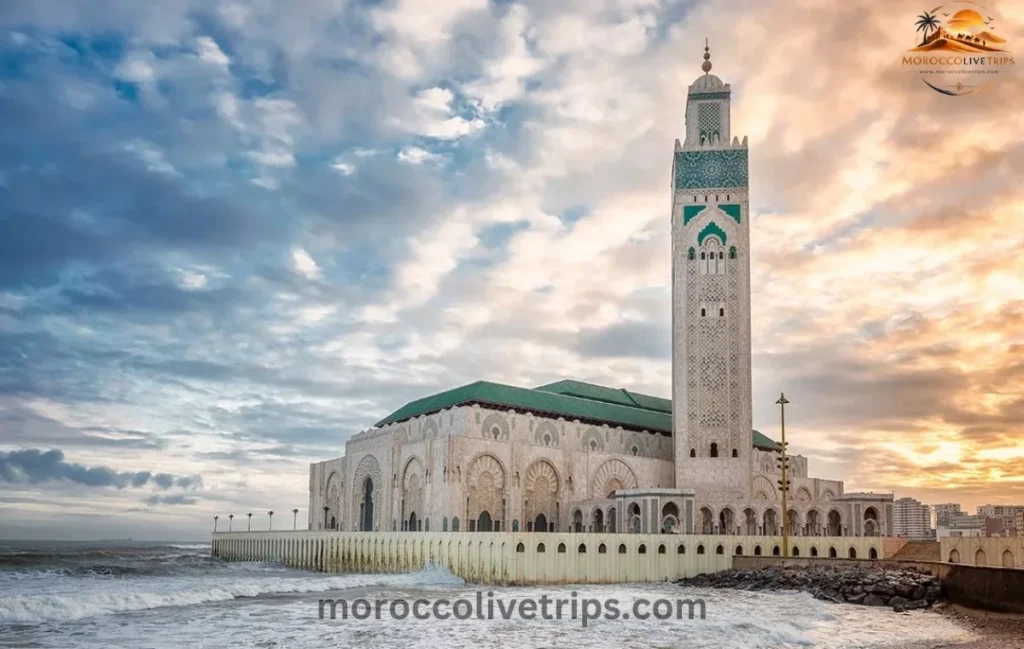
Your driver meets you in the arrivals hall at Mohammed V International Airport, or at your hotel or the cruise port. Casablanca is not an imperial city, but it is home to Morocco’s most spectacular modern monument, the Hassan II Mosque. Completed in 1993, it stands on a platform over the Atlantic and its minaret is around 210 metres tall. Non-Muslim visitors can enter on guided tours at set times; the craftsmanship inside, from carved cedar ceilings to hand-cut zellige tiles, is a fine introduction to the traditional arts you will see all week.
Later, see the Art Deco buildings of the city centre, the Habous quarter or the Corniche. Our guide to Casablanca attractions has more ideas. Overnight: Casablanca.
Drive one hour up the coast to Rabat and spend the day there. Begin at the Hassan Tower, the minaret of a vast mosque begun by the Almohad sultan Yaqub al-Mansur at the end of the 12th century and left unfinished at his death, surrounded by the stumps of its columns. Opposite stands the white Mausoleum of Mohammed V, resting place of the king who led Morocco to independence, with royal guards at its gates.
Next, walk through the Kasbah of the Udayas, a fortress on the cliff above the mouth of the Bou Regreg river, with whitewashed lanes, blue doors and a peaceful Andalusian garden. In the afternoon, visit the Chellah, where the ruins of the Roman town of Sala lie beside a walled Marinid necropolis, home to storks nesting on the old minaret. End with the Rabat medina or a coffee overlooking Salé across the river. Overnight: Rabat. Driving: about 90 km, 1 hr – 1 hr 15.

Leave Rabat after breakfast for Meknes (about 1 hr 45). Sultan Moulay Ismail made this his capital in 1672 and spent 55 years building an imperial city of walls, palaces, granaries and stables on an extraordinary scale. See Bab Mansour, often described as the most beautiful gate in Morocco, and Place el-Hedim in front of it; the Mausoleum of Moulay Ismail, whose courtyards are open to non-Muslim visitors (the tomb chamber itself is not); and the Heri es-Souani, the sultan’s enormous granaries and stables.
Continue to Moulay Idriss Zerhoun, a white hillside town and one of Morocco’s holiest places, built around the tomb of Idris I, who founded the first Moroccan Islamic state in 789. A short drive away, explore Volubilis, the best-preserved Roman site in Morocco, with mosaics still in place in its houses, the basilica, the Capitol and the triumphal arch. Arrive in Fes in the early evening. Overnight: Fes. Driving: about 250 km in total, 3 hr 30 – 4 hr.
Today belongs to Fes el-Bali, the old walled medina and the heart of the oldest imperial city. With your licensed local guide, enter through Bab Bou Jeloud and follow the Talaa Kebira, the main street, down into the medina. Visit the Bou Inania Madrasa, built by the Marinid sultan Abu Inan in the 1350s, and the smaller, exquisite Al-Attarine Madrasa; see the Nejjarine fountain and woodwork museum; and pass the doors of Al Quaraouiyine, founded in 859 by Fatima al-Fihri and widely regarded as one of the oldest continuously operating places of learning in the world.
In the afternoon, watch coppersmiths at Place Seffarine and look down on the Chouara tannery, where hides are still dyed in stone vats. Read our Fes medina guided tour tips before you go. Overnight: Fes.

This morning, see the “new” Fes, built by the Marinids in the 13th century. Admire the golden doors of the Royal Palace (Dar el-Makhzen), walk through the Mellah, the historic Jewish quarter, with its carved wooden balconies and the restored Ibn Danan synagogue, and continue to the viewpoint at the Merenid Tombs or Borj Nord for a panorama over the whole medina.
Visit a ceramics workshop in the potters’ quarter, where you can watch artisans shape, glaze and hand-cut the tiles for zellige mosaics. The afternoon is free: return to the souks, enjoy a traditional hammam, or take a Fassi cooking class. If you would rather see more of the north, swap this day for a day trip to Chefchaouen. Our article on excursions from Fes lists the options. Overnight: Fes.

Today you cross from the north to the south of Morocco. Drive up into the Middle Atlas to Ifrane, a town of chalet-style roofs, and the cedar forests around Azrou, home to wild Barbary macaques. Continue along the foot of the mountains past Khenifra and Beni Mellal, through farmland and olive groves, to Marrakech, which you reach in the late afternoon. It is a long but varied day. If you prefer, we can take the faster motorway via Rabat and Casablanca instead. Overnight: Marrakech. Driving: about 480–530 km depending on the route, 6 – 8 hr.
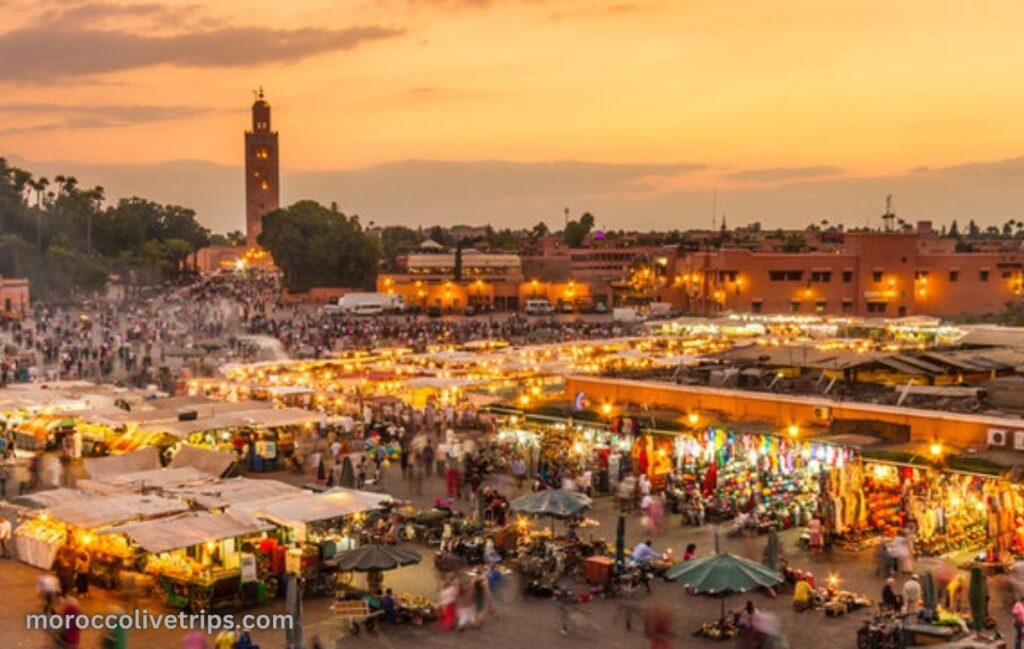
Spend the day with a licensed guide in the Red City, founded by the Almoravids around 1070. Start at the Koutoubia Mosque, whose 12th-century Almohad minaret is the model for the Hassan Tower in Rabat. Then visit the Saadian Tombs, the richly decorated burial place of the 16th-century Saadian sultans; the ruins of the El Badi Palace, once one of the most lavish palaces in the Islamic world, stripped by Moulay Ismail to build Meknes; and the 19th-century Bahia Palace with its painted ceilings and courtyards.
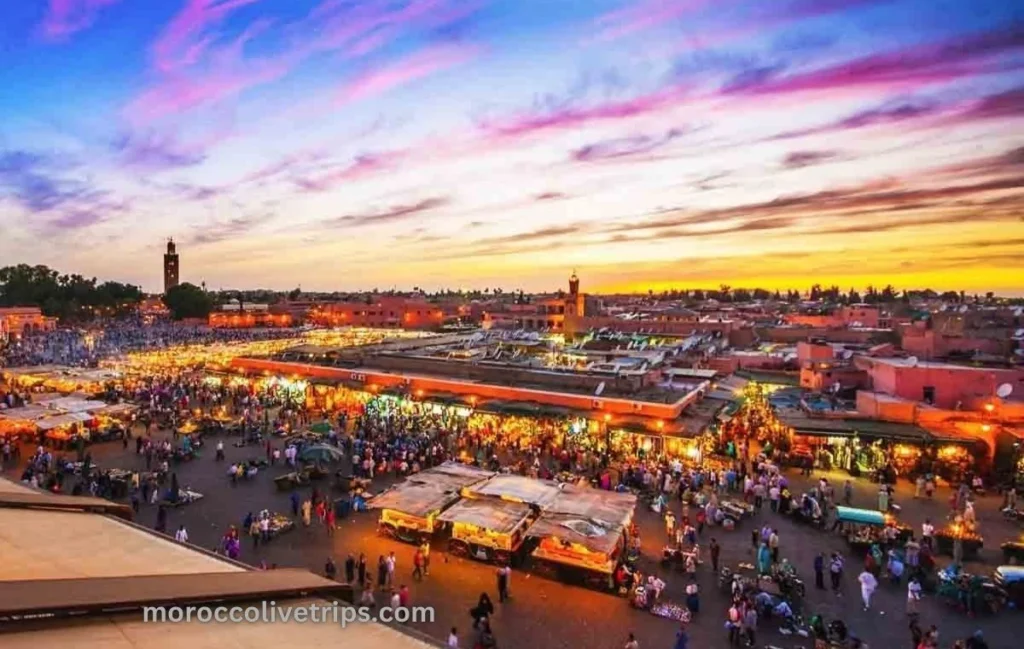
In the afternoon, see the Ben Youssef Madrasa and the souks of the medina, then perhaps the Majorelle Garden. In the evening, go to Jemaa el-Fnaa, the great square whose storytellers, musicians and food stalls are recognised by UNESCO as part of the world’s intangible cultural heritage. Overnight: Marrakech.
Enjoy a final morning in Marrakech before your driver takes you to Marrakech Menara Airport. If your flight leaves from Casablanca, we drive you back to Mohammed V Airport (about 240 km, roughly three hours). Many travellers add extra nights in Marrakech, or a trip to Essaouira on the coast.
The classic 8-day itinerary suits most travellers, but the route is easy to adapt. Here are the versions we plan most often.
Casablanca, Rabat, Meknes, Volubilis, one full day in Fes and a full day in Marrakech.
See the 6-day plan
A loop that starts and ends in Marrakech, ideal if your flights are into and out of the Red City.
See the Marrakech loop
Add the Blue City, more time in Fes and a slower pace throughout.
See the 10-day plan
Fes and Marrakech linked by a night in the Erg Chebbi dunes instead of the Middle Atlas road.
See the desert versionDay 1 Casablanca arrival and Hassan II Mosque, continuing to Rabat · Day 2 Rabat in the morning, then Meknes and Volubilis to Fes · Day 3 Fes guided medina day · Day 4 Fes to Marrakech · Day 5 Marrakech guided day · Day 6 departure. It is efficient, but you lose the second day in Fes and the night in Rabat.
If you fly in and out of Marrakech, we run the loop clockwise: Marrakech → Casablanca and Rabat → Meknes and Volubilis → two nights in Fes → back to Marrakech through the Middle Atlas, with a guided day in Marrakech at the start or end. It avoids a long one-way transfer at the end of your trip; the day-by-day plan is below. Our Marrakech city tour package can be added for extra time in the Red City.
Ten days lets you add the Blue City of Chefchaouen in the Rif Mountains between Rabat and Fes, a third night in Fes, and more time in Marrakech. Popular extras include a night in Essaouira or a day in the Atlas Mountains. For a longer journey across the whole country, see our 14-day Morocco multi-city tour.
Many travellers want both the cities and the desert. Instead of driving from Fes to Marrakech through the Middle Atlas, you cross to the dunes of Erg Chebbi, spend a night in a desert camp, and return west through the Todra Gorge, the Dades Valley and Ait Ben Haddou. Our 8 day tour from Casablanca to the desert via Chefchaouen and Fes does exactly this, and our Casablanca to Marrakech tour via the desert compares the 6 to 10-day versions.
If your flights arrive in and leave from Marrakech, there is no need for a one-way trip. This loop visits all four imperial cities and brings you back to the Red City, with two nights in Fes and a full guided day in Marrakech. It is the version we recommend for travellers flying from the UK and Europe, where Marrakech has the most direct routes.
| Day | Route and highlights | Overnight |
|---|---|---|
| 1 | Arrival in Marrakech; evening in Jemaa el-Fnaa | Marrakech |
| 2 | Marrakech with a licensed guide: Koutoubia, Bahia Palace, Saadian Tombs, Ben Youssef Madrasa, souks | Marrakech |
| 3 | Marrakech → Casablanca (Hassan II Mosque) → Rabat | Rabat |
| 4 | Rabat sightseeing → Meknes → Moulay Idriss → Volubilis → Fes | Fes |
| 5 | Fes el-Bali with a licensed guide, Fes el-Jdid in the afternoon | Fes |
| 6 | Fes → Ifrane → cedar forest of Azrou → Beni Mellal → Marrakech | Marrakech |
| 7 | Free morning, transfer to Marrakech Menara Airport | – |
Day 3 is the busiest: the motorway to Casablanca takes about three hours, so we time your arrival for a guided tour of the Hassan II Mosque, then continue one hour to Rabat for the evening. Rabat’s main sights fit into the following morning before you drive inland to Meknes and Volubilis. Because the guided day in Marrakech comes at the start of the trip, you see the city fresh, and day 7 is relaxed before your flight.
Instead of returning to Marrakech through the Middle Atlas on day 6, you can travel from Fes to the Erg Chebbi dunes, spend a night in a desert camp near Merzouga, and come back over the High Atlas via the Todra Gorge, the Dades Valley and Ait Ben Haddou. This adds two days, making a nine-day trip. Our private tour from Marrakech to Merzouga describes the desert section in detail.
Arriving in Fes, or in Tangier by ferry from Spain? We start the tour wherever you land. From Tangier, a typical route runs south to Chefchaouen, Fes, Meknes, Rabat and Casablanca, ending in Marrakech. From Fes, we begin with two nights in the medina, visit Meknes and Volubilis, continue to Rabat and Casablanca, and finish in Marrakech. Tell us your flight or ferry details and we will suggest the most efficient order.
Each city deserves its own visit. Here are the sights we include on our tours, and what makes each city different.
Fes is the oldest of the imperial cities. It was founded on the banks of the Fes river by Idris I in 789 and expanded by his son Idris II, and it became one of the great centres of learning in the Islamic world. Refugees from Kairouan and Andalusia gave its two halves their character, and the Marinid sultans of the 13th and 14th centuries filled it with madrasas. Fes el-Bali remains one of the largest car-free urban areas in the world.
Marrakech was founded by the Almoravids around 1070 and gave its name to the country itself. Under the Almohads it became the capital of an empire that stretched into Spain, and under the Saadians in the 16th century it was rebuilt in splendour. Today it is Morocco’s most visited city, a mix of historic monuments, busy souks, gardens and an energetic street life that peaks every evening in Jemaa el-Fnaa.
Our list of the best things to do in Marrakech has more ideas, and our Marrakech full-day walking tour covers the medina in depth.

When Moulay Ismail became sultan in 1672, he chose Meknes over Fes and Marrakech as his capital and set out to build an imperial city to rival the courts of Europe. The result was some 40 km of walls, monumental gates, palaces, granaries and stables, much of it built with materials taken from elsewhere, including the El Badi Palace in Marrakech and the Roman ruins at Volubilis. Meknes is quieter and less visited than Fes, which is part of its charm.
Rabat’s story begins with a 12th-century Almohad fortress (ribat) at the mouth of the Bou Regreg. Sultan Yaqub al-Mansur planned it as a great capital, but work stopped at his death. Andalusian refugees later settled here, and in 1912 the French made Rabat the capital, a role it kept after independence in 1956. Today it is an orderly, green city where the old and new sit comfortably side by side.
If you have limited time, this comparison helps you decide where to spend extra nights.
| Fes | Marrakech | Meknes | Rabat | |
|---|---|---|---|---|
| Atmosphere | Medieval, intense, scholarly | Lively, colourful, cosmopolitan | Calm, monumental | Relaxed, green, modern |
| Best for | Architecture, crafts, history | Palaces, gardens, souks, nightlife | Royal monuments, Volubilis | Easy sightseeing, coast |
| Time needed | 2 nights minimum | 2 nights minimum | Half a day | Half to one full day |
| Guide recommended? | Essential in the medina | Strongly recommended | Helpful | Optional |
| UNESCO listing | 1981 | 1985 | 1996 | 2012 |
Most travellers say Fes is the most memorable of the four and Marrakech the most fun. Meknes is the surprise: few people plan to love it, but many do. Rabat is the gentle start that makes the busier medinas easier to enjoy.
Some of the best moments on an imperial cities tour happen between the cities.
Set in open farmland below the Zerhoun hills, Volubilis was a Roman town on the edge of the province of Mauretania Tingitana. It was later home to Idris I before he founded Fes. Its mosaics of Orpheus, Bacchus and the labours of Hercules are still in place, and its triumphal arch stands alone against the sky. Volubilis has been a UNESCO World Heritage Site since 1997. Our Volubilis tour guide covers the site in detail.
This whitewashed town spills over two hills a few kilometres from Volubilis. The mausoleum of Idris I makes it one of the most important pilgrimage sites in Morocco. Non-Muslims cannot enter the shrine, but the view from the terraces above the town is superb.
Many imperial cities tours add the north: the blue medina of Chefchaouen in the Rif Mountains, and Tangier on the Strait of Gibraltar. See our Chefchaouen and Fes sightseeing tour and our Tangier city tour.
The drive from Fes to Marrakech crosses cedar forests, lakes and Berber farmland. Ifrane, built in an Alpine style in the 1930s, and the cedar forests of Azrou, with their Barbary macaques, are the highlights.
After the intensity of the medinas, the Atlantic port of Essaouira, with its ramparts, fishing harbour and sea breeze, is a relaxing way to end the trip. See our Essaouira full-day excursion.
Staying in a traditional riad is one of the pleasures of an imperial cities tour. These restored townhouses are built around a central courtyard, often with a fountain or garden, and many have roof terraces with views over the medina. We choose accommodation to suit your budget and confirm every property in your quote.
| City | Nights (8-day tour) | Typical stay | Upgrade option |
|---|---|---|---|
| Casablanca | 1 | City-centre or Corniche hotel | Ocean-view hotel |
| Rabat | 1 | Riad in the medina or a central hotel | Boutique riad near the Kasbah |
| Fes | 3 | Traditional riad in Fes el-Bali | Palace riad with pool and garden |
| Marrakech | 2 | Riad in the medina | Luxury riad or hotel with garden and pool |

Medina riads are usually a short walk from the nearest road; your driver and the riad staff help with luggage. If you prefer a hotel with lifts and parking at the door, tell us and we will plan accordingly. For high-end stays throughout, see our luxury Morocco tour packages.
You travel in a modern, air-conditioned vehicle sized for your group, such as a Toyota Land Cruiser for couples and small groups or a Mercedes Vito minivan for families and larger groups, subject to availability. Your English-speaking Moroccan driver stays with you for the whole tour, handles every transfer and recommends places to eat along the way. Child seats are available on request.
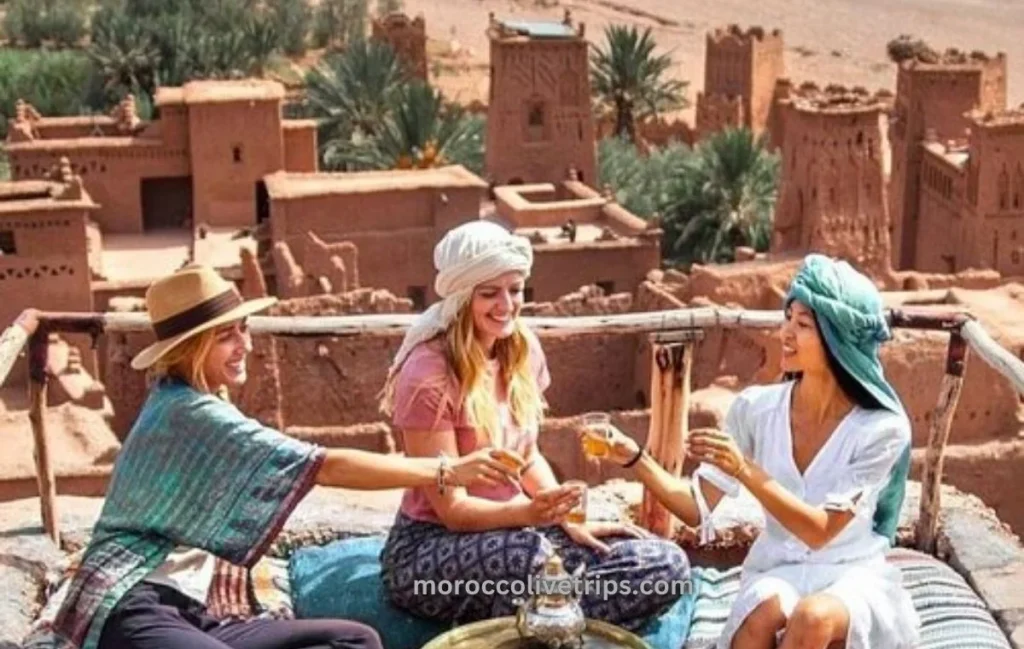
The medinas of Fes and Marrakech are best explored with a licensed local guide. Guides are trained and authorised by the Moroccan authorities, and the good ones are historians, storytellers and navigators in one. On our standard itinerary, guided visits are included in Fes and Marrakech; guides for Rabat and Meknes can be added. We can request guides who speak French, Spanish or German as well as English, subject to availability.
Learn more about our approach on our page about Morocco tours with local guides.
Your quote lists every inclusion clearly. As a guide, the standard 8-day private imperial cities tour includes:
We can add dinners, entrance fees and extra guides so you pay one price up front. Just ask when you request your quote.
Because every tour is private and planned around you, the price depends on your choices. We send a free, itemised quote for your dates. The main factors are:
Tell us your budget and we will tell you honestly what it covers. For broader context, read our guide to whether Morocco is expensive to visit.
Send us your dates, group size and preferred hotels. We’ll reply with a personalised imperial cities itinerary and a clear price.
Because the imperial cities lie in the north and centre of Morocco, away from the Sahara, the tour works well for much of the year. Walking the medinas is most pleasant when it is not too hot.
| Season | Months | What to expect |
|---|---|---|
| Spring | March – May | Warm, sunny and green. Ideal for walking the medinas. Popular, so book early. |
| Summer | June – August | Hot in Fes, Meknes and Marrakech, often above 35–40°C; Rabat and Casablanca are cooled by the ocean. Plan sightseeing for the morning and evening. |
| Autumn | September – November | Warm, settled weather. One of the best times to visit. |
| Winter | December – February | Mild, often sunny days and cool nights. Some rain in the north. Fewer visitors at the monuments. |
Winter is an underrated time for this tour: the cities are calm, the light is clear and riads are cosy with their fireplaces. During Ramadan, monuments remain open, though hours can change and some restaurants close in the daytime. Our guide to the best time to visit Morocco covers the whole country month by month.
Most active mosques in Morocco are closed to non-Muslims. The main exception is the Hassan II Mosque in Casablanca, which offers guided tours. You can, however, visit many historic religious buildings that are no longer used for prayer, including the madrasas of Fes and Marrakech, the Saadian Tombs and the courtyards of the Mausoleum of Moulay Ismail.
Dress modestly in the medinas and at religious sites: shoulders and knees covered for both men and women. Lightweight long trousers, skirts and shirts are comfortable in the heat. A scarf is useful. See our guide on what to wear in Morocco as a tourist.
Always ask before photographing people, and expect that some will say no or ask for a small tip. Photography is not allowed inside some sacred spaces.
Bargaining is normal in the souks. Take your time, be friendly and decide your price before you start. You are never obliged to buy, even after a demonstration or a glass of mint tea. Your guide can recommend reputable cooperatives and workshops.
Medina lanes are uneven, often steep and shared with handcarts and donkeys (listen for “balak”, meaning “watch out”). Wear comfortable shoes. If someone offers to show you the way, a polite “no thank you” is enough; with a guide, this is rarely an issue.
Moroccan Arabic (Darija) and Tamazight are the main spoken languages, and French is widely used. English is increasingly common in tourism. Your driver and guides speak English. Our article on what language they speak in Morocco explains more.
If the Sahara is a must for you, choose the imperial cities and Sahara version or ask us to combine the two. If you want something entirely your own, our tailor-made Morocco tours start from your ideas.
We are a Morocco-based company that runs private tours only. Our team lives in Morocco and works with local guides in the cities we visit, so we can advise honestly on how many nights each city deserves, which riads suit you and when to visit. Read more about our local Morocco tour company, or browse all our Morocco tour packages.
Rabat, Chefchaouen, two nights in Fes, the Sahara and Marrakech.
View the 8-day tour
Compare all trip lengths for the route from Casablanca to Marrakech through the Sahara.
Compare itineraries
Design your own route with our team, from city breaks to grand tours.
Plan a custom tourTell us your travel dates, your arrival and departure airports, how many people are travelling and how many days you have. Let us know your preferred accommodation and any special interests, such as architecture, food, crafts or Jewish heritage.
Prefer to talk? WhatsApp or call +212 601-339154 or email moroccolivetrips@gmail.com. You can also reach us through our contact page.
Fes, Marrakech, Meknes and Rabat. Each served as the capital of Morocco under one or more dynasties, and all four are UNESCO World Heritage Sites. Fes is the oldest, founded in the late 8th century, and Rabat is the capital today.
Eight days is ideal, with two nights each in Fes and Marrakech. Six days is possible if you are short on time. Ten days lets you add Chefchaouen or extra nights, and 8 to 10 days lets you add a night in the Sahara.
From Casablanca: Rabat, then Meknes, Moulay Idriss and Volubilis on the way to Fes, then across the Middle Atlas to Marrakech. If you fly in and out of Marrakech, the same cities can be visited as a loop.
Yes. The vehicle, driver and guides are for your family or group only, and you can start on any date you choose.
Most travellers find Fes the most memorable for its intact medieval medina and Marrakech the liveliest for its palaces, souks and square. Meknes is quieter and often a pleasant surprise, and Rabat is the most relaxed.
Yes. On the standard itinerary, licensed local guides lead your visits in Fes and Marrakech. Guides for Rabat and Meknes can be added, and guides in other languages can be requested.
Yes. The Roman ruins of Volubilis and the holy town of Moulay Idriss are visited on the drive from Meknes to Fes.
Yes. Instead of driving from Fes to Marrakech through the Middle Atlas, you can travel via the Erg Chebbi dunes with a night in a desert camp, returning through the Todra Gorge, the Dades Valley and Ait Ben Haddou. This makes the tour 8 to 10 days.
Yes. Chefchaouen fits between Rabat and Fes and adds one or two days. It is included on our 10-day imperial cities version.
Yes. We run the imperial cities as a loop from Marrakech, and we can start in Tangier or Fes. Tell us where you arrive and leave and we will plan the route.
Most active mosques in Morocco are closed to non-Muslims. The Hassan II Mosque in Casablanca is open on guided tours, and you can visit historic madrasas, the Saadian Tombs and the courtyards of the Mausoleum of Moulay Ismail.
Usually in traditional riads in the medinas of Fes, Marrakech and Rabat, and a comfortable hotel in Casablanca. Every property is confirmed in your quote, and luxury options are available.
A modern air-conditioned vehicle sized for your group, such as a Toyota Land Cruiser or a Mercedes Vito minivan, subject to availability, reserved for you for the whole tour.
The price depends on the number of days, group size, accommodation level, guides and season. We send a free, itemised quote for your dates.
Spring (March to May) and autumn (September to November) are best for walking the medinas. Winter is mild and quiet, while summer is very hot inland, so sightseeing is planned for mornings and evenings.
Yes. Driving days are mostly short, the pace is flexible and we can choose hotels with easy access. Guided walks can be shortened and broken up with rest stops.
Modest clothing that covers shoulders and knees, comfortable walking shoes for uneven medina lanes, and a light layer for cool evenings. A scarf is useful for women visiting religious sites.
Request a quote through the form, WhatsApp or email. When you are happy with the plan, a deposit confirms your booking. The balance and cancellation terms are set out in your quote and our booking terms.
Tell us when you arrive and how many days you have. We’ll plan your private Morocco imperial cities tour around you, with your own driver, expert local guides and a clear price.