Marrakech is one of the most sensory, layered, and rewarding cities on earth – but first-time visitors often spend their first day completely overwhelmed and their second day doing it wrong. This guide was written by our local Moroccan team at Morocco Live Trips, who guide hundreds of international travelers through Marrakech every year. We are not a travel blog. We live here, work here, and know every corner of this city.
Below you will find the real best things to do in Marrakech – with honest advice, actual prices, and insider tips that most travel guides won’t tell you.
Jemaa el-Fna Square – The Heart of Marrakech
Jemaa el-Fna is the living center of Marrakech and a UNESCO-listed intangible cultural heritage site – the only public square in the world to hold that designation. During the day it hosts snake charmers, henna artists, Amazigh storytellers, and orange juice stalls (fresh-squeezed for 4 MAD – about $0.40). After sunset it completely transforms: over 100 food stalls set up open-air kitchens filling the square with smoke, music, and the smell of grilled lamb and harira soup.
Our honest tip: The orange juice vendors and henna women near the edges of the square will approach you aggressively. A firm but polite “la shukran” (no thank you in Arabic) works every time. Never agree to a price you haven’t confirmed upfront.
Best time to visit: Arrive at 6:00 PM to watch the transformation from daytime market to evening carnival. This is genuinely one of the most spectacular things you will witness in Morocco.
Nearby: The square sits at the entrance to the main souks and is a 5-minute walk from Koutoubia Mosque – the 12th-century minaret that serves as Marrakech’s most iconic landmark and your navigational reference point throughout the Medina.
The Marrakech Medina – Getting Lost (on Purpose)
The Marrakech Medina (old walled city) is a UNESCO World Heritage Site and the most densely layered historic neighborhood in North Africa. Inside its 19km of pink-ochre walls you will find over 100 mosques, dozens of traditional funduqs (merchant caravanserais), centuries-old hammams, and a souk system so intricate that even locals need time to navigate it.
Key Medina neighborhoods to explore:
- Mouassine – the most photogenic quarter, home to the 16th-century Mouassine Mosque and a cluster of the city’s best concept stores and art galleries
- Derb Dabachi – quieter residential streets where you see authentic local life away from the tourist trail
- Mellah (Jewish Quarter) – the historic Jewish neighborhood near the Royal Palace, with distinctive yellow-painted balconies and a fascinating covered market
Do not hire unofficial “guides” who approach you in the street. They will charge you $30–50 to lead you into shops where they earn commission. Book a licensed private Marrakech tour if you want genuine historical context – the difference in experience quality is enormous.
Walking the Medina takes 3–4 hours minimum if done properly. Wear comfortable shoes. The streets are uneven, narrow, and often shared with motorbikes that appear with no warning.
Bahia Palace – Morocco’s Most Beautiful Interior
Bahia Palace (Qasr al-Bahia, meaning “Palace of the Brilliant”) was built in the late 19th century for Si Moussa, a Grand Vizier of Morocco. It is widely considered the finest example of Moroccan-Andalusian palace architecture in Marrakech – and unlike some of the city’s other monuments, it is exceptionally well preserved.
What makes it unmissable:
- 8 hectares of interconnected courtyards, gardens, and reception halls
- Intricate zellij tilework, carved cedarwood ceilings, and hand-painted plaster (stucco) throughout
- The Grand Courtyard – a stunning open space with a marble floor, citrus trees, and carved archways that represents the pinnacle of Moroccan craftsmanship
Entry fee: 70 MAD (~$7) per person. Open daily 9:00 AM – 5:00 PM.
Insider tip: Visit on a weekday morning before 10:00 AM to avoid tour groups. The light through the courtyard tiling at that hour is exceptional for photography.
Combine with: Saadian Tombs and El Badi Palace – all three are within a 10-minute walk of each other in the southern Medina.
Saadian Tombs – Hidden for 300 Years
The Saadian Tombs are one of Marrakech’s most historically significant sites – and their backstory is extraordinary. Built in the late 16th century by Sultan Ahmad al-Mansur to house the Saadian royal dynasty, they were sealed off by Sultan Moulay Ismail in the 17th century after he destroyed most Saadian monuments. They remained completely hidden until 1917, when French archaeologists discovered them via aerial photography.
What they found inside had been perfectly preserved for three centuries: 66 bodies in the main chamber surrounded by Italian Carrara marble columns, gilded cedar carvings, and walls covered in geometric zellij mosaic work. The central mausoleum – the Hall of Twelve Columns – is among the most refined pieces of Islamic funerary architecture in the world.
Entry fee: 70 MAD (~$7). Pro tip: Book a guided Marrakech city tour that includes the tombs – a knowledgeable guide transforms this from a pretty room into a gripping history lesson.
Majorelle Garden & the YSL Museum
Majorelle Garden is arguably the most photographed spot in all of Morocco. Created by French painter Jacques Majorelle over 40 years starting in 1923, and later restored by Yves Saint Laurent and Pierre Bergé after they purchased it in 1980, the garden is a masterpiece of botanical design built around a cobalt blue villa that has become one of the most iconic images of Marrakech.
What’s inside:
- 3 acres of exotic plants including cacti, palms, and water lilies from five continents
- The Villa Bou Saf Saf painted in the signature “Majorelle Blue” – a color YSL trademarked
- The Musée Yves Saint Laurent Marrakech (YSL Museum) – a world-class fashion museum opened in 2017 showcasing 50 years of couture. Separate entrance, absolutely worth the extra ticket
- The Berber Museum inside the garden covering Amazigh (Berber) jewelry, textiles, and cultural artifacts
Entry fees: Garden – 150 MAD (~$15). YSL Museum – 100 MAD (~$10). Book tickets online in advance – this is the single most popular attraction in Marrakech and queues can be 45–60 minutes without a pre-booked ticket.
Location: Gueliz (new city), a 15-minute taxi ride from Jemaa el-Fna. Petite taxi fare: 25–35 MAD.
Ben Youssef Madrasa – The Most Ornate Building in Morocco
The Ben Youssef Madrasa is a 14th-century Islamic college (Quranic school) that once housed up to 900 students from across the Islamic world. It was the largest madrasa in North Africa during its peak and is now the finest example of Marinid-era architecture in Marrakech.
Every surface inside is covered in one of three traditional Moroccan decorative arts:
- Zellij – hand-cut geometric mosaic tilework on the lower walls
- Stucco – intricately carved plaster panels with floral and geometric patterns
- Cedarwood – carved wooden screens and muqarnas (honeycomb vaulting) on the ceilings
The central courtyard with its marble pool and the gallery of student cells above are extraordinary. This is one of the most architecturally refined spaces in all of Morocco.
Entry fee: 70 MAD (~$7). Combined ticket with other Medina monuments available.
El Badi Palace – Magnificent Ruins
El Badi Palace (“The Incomparable”) was built by Sultan Ahmad al-Mansur in 1578 following a military victory over Portugal. It was once one of the most opulent palaces in the world – Italian marble, gold leaf, and onyx from the Sudan – and took 25 years to complete. Sultan Moulay Ismail stripped it completely bare 100 years later to build his palace in Meknes, leaving only the shell you see today.
What remains is still breathtaking: massive sunken gardens, rooftop terraces with panoramic views over Marrakech, nesting stork colonies on the ramparts, and the original minbar (pulpit) from the Koutoubia Mosque displayed in a dedicated pavilion.
Entry fee: 70 MAD (~$7). The rooftop views at sunset are spectacular and completely underrated.
The Souks of Marrakech – What to Buy & What to Avoid
The souks of Marrakech are divided into specialized areas by craft – a system unchanged since the medieval period. Navigating them without knowing this structure means wandering aimlessly and getting overcharged. Here is what you need to know:
Key souk zones:
| Souk | Specialty | Location |
| Souk Semmarine | Textiles, carpets, clothing | Main entrance from Jemaa el-Fna |
| Souk el-Attarine | Spices, perfumes, argan oil | North of Souk Semmarine |
| Souk des Teinturiers | Leather dyeing (the famous tanneries) | Near Bab Debbagh |
| Souk Haddadine | Metalwork, lanterns | Northern Medina |
| Souk Cherratine | Leatherwork, bags | Central Medina |
| Souk Zrabia | Carpets and rugs | Central Medina |
Honest buying advice:
- Opening prices are 3–5x the fair price. Negotiating down to 40–50% of the first quote is normal and expected – it is not rude, it is the established custom
- Argan oil: Many “pure argan oil” products in tourist souks are diluted with cheaper oils. Buy from a women’s argan cooperative for guaranteed authenticity – ask your guide to take you to one
- Spices: Pre-packaged spice mixes from market vendors are often low quality. The Épices de Marché near Place Rahba Kedima has high-quality, properly labeled spices
- Leather goods: Genuine leather from the tanneries is the best value buy in Marrakech – budget bags, belts, and babouche slippers are all excellent
Marrakech Food Scene – What to Eat & Where
Moroccan cuisine is one of the most underrated in the world. Marrakech is the best city in Morocco to experience it. Here is what to eat and where to find the real thing:
Must-eat dishes in Marrakech:
- Tagine – slow-cooked meat or vegetable stew in a conical clay pot. The lamb and prune tagine at any traditional Medina restaurant is exceptional. Average price at a local restaurant: 60–90 MAD ($6–9)
- Pastilla – a flaky pastry filled with pigeon (or chicken), almonds, and cinnamon with powdered sugar. One of the great dishes of Moroccan cuisine and unique to Morocco. Find it at Café Clock in the Medina (60 MAD)
- Harira – a rich tomato, lentil, and lamb soup traditionally eaten to break the Ramadan fast but served year-round. A bowl at Jemaa el-Fna: 15–20 MAD
- Mechoui – whole slow-roasted lamb sold by weight in the Mechoui Alley (Souk Ahal Fes, off Jemaa el-Fna). A 200g portion with bread and cumin costs around 50 MAD – this is some of the best meat you will eat in your life
- B’stilla au lait – a Marrakchi dessert specialty: almond milk, crushed almonds, orange blossom water, and cinnamon. Order it at any traditional café for 20–25 MAD
Where locals actually eat (not tourist traps):
- Chez Lamine el-Haffa (Mechoui Alley) – legendary roast lamb, cash only, no menus, open from 11:00 AM until sold out
- Café des Épices (Rahba Kedima Square) – rooftop terrace overlooking the spice market, excellent coffee and pastries, fair prices
- Restaurant El Bahia (near Bahia Palace) – family-run, Moroccan home cooking, set lunch for 80 MAD
Avoid: any restaurant on the main edges of Jemaa el-Fna with touts outside pulling people in. These are almost universally overpriced tourist traps with mediocre food.
Day Trips from Marrakech Worth Taking
Marrakech is the perfect base for some of the best day trips in Morocco. Here are the ones genuinely worth your time:
Ouarzazate Day Trip from Marrakech
Cross the High Atlas Mountains via the spectacular Tizi n’Tichka pass (2,260m) to reach Ouarzazate – the “Hollywood of Morocco” where films like Gladiator, Lawrence of Arabia, and Game of Thrones were filmed. Visit Aït Benhaddou – a UNESCO World Heritage ksar (fortified village) that is one of the most photogenic places in North Africa. Full day: 8–10 hours from Marrakech.
Atlas Mountains Trip from Marrakech
The Ourika Valley and the Imlil region are both under 90 minutes from Marrakech. The Imlil valley is the starting point for treks up Mount Toubkal (4,167m – highest peak in North Africa) and offers genuine Amazigh Berber village experiences. The contrast between the dusty city and the green mountain valleys is extraordinary.
Day Trip to Essaouira from Marrakech
The Atlantic coast city of Essaouira – a UNESCO-listed fortified port city – is 2.5 hours from Marrakech. Its blue-and-white Medina, Portuguese ramparts, wind-swept beaches, and exceptional seafood make it one of the most atmospheric cities in Morocco. If you have even one free day in Marrakech, this is the day trip to take.
3-Day Desert Tour from Marrakech to Merzouga
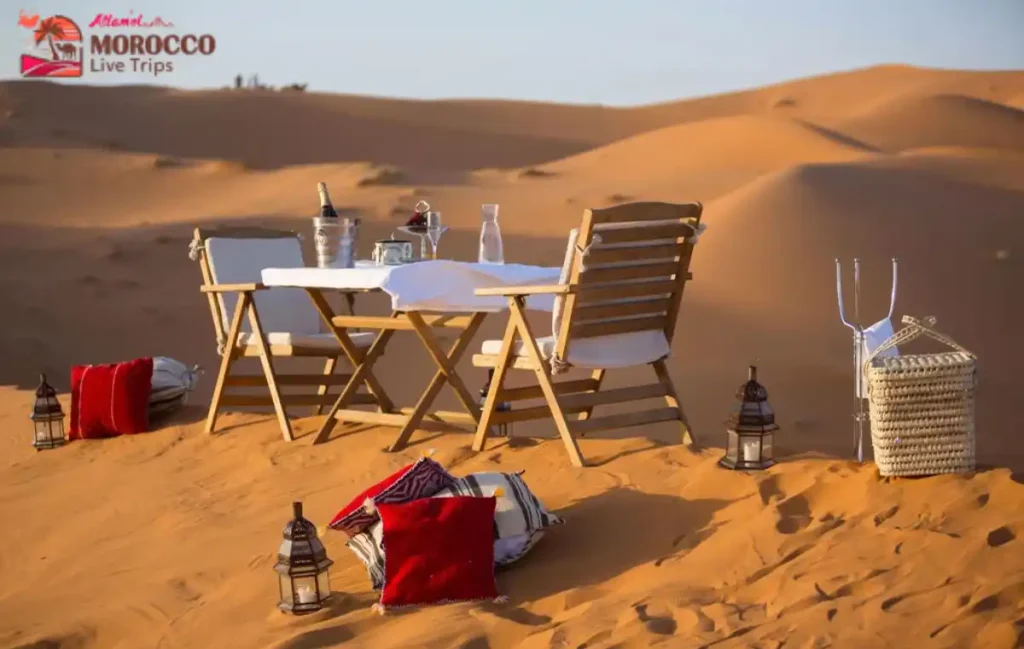
Not technically a day trip – but the most popular extended tour from Marrakech. Erg Chebbi dunes near Merzouga are the classic Sahara Desert experience: camel ride at sunset, night in a desert camp under an astonishing sky, and sunrise over the dunes. This is the experience most people come to Morocco for. Our 3-day Marrakech to Merzouga tour covers the full route including Aït Benhaddou, the Draa Valley, and the Dades Gorge.
Marrakech Itinerary – How to Plan 2, 3, 4 & 7 Days
2 Days in Marrakech
- Day 1: Jemaa el-Fna → Souks → Ben Youssef Madrasa → Mouassine neighborhood → evening at the square
- Day 2: Bahia Palace → Saadian Tombs → El Badi Palace → Majorelle Garden → YSL Museum
3 Days in Marrakech
Add to the 2-day plan:
- Day 3: Full-day Atlas Mountains trip or Essaouira day trip
4 Days in Marrakech
Add to the 3-day plan:
- Day 4: Cooking class in the Medina + Hammam experience at a traditional bathhouse (Hammam el-Bacha – 50 MAD, restored 1930s hammam)
7 Days – Marrakech + Desert
The ideal Morocco first visit combines 2 days in Marrakech with a 3-day desert tour to Merzouga and a return via Fes or an Essaouira day trip on the final day. See our full 7-day Morocco tour from Marrakech for a structured private itinerary.
Practical Travel Tips for Marrakech
Getting around:
- Petite taxis (small red taxis) are the best way to get around the new city (Gueliz). Always insist on the meter – short journeys should cost 15–35 MAD. Never accept a fixed price before the meter reading
- The Medina is mostly pedestrian-only – you will walk everywhere. Most major sites are within 20–30 minutes on foot of Jemaa el-Fna
- Carriage rides (caleches) from the square are a tourist experience – agree on a price before getting in (typically 150–200 MAD for a 30-minute circuit)
Money:
- Cash is king in the Medina. Most souks and small restaurants do not accept cards
- ATMs are widely available in Gueliz and around the main square. Withdraw MAD locally – exchange rates at banks and ATMs are far better than airport exchange desks
- Current rate: 1 USD ≈ 10 MAD | 1 EUR ≈ 11 MAD | 1 GBP ≈ 12.5 MAD (2026)
Dress code:
- Marrakech is a conservative Muslim city. Shoulders and knees should be covered when visiting mosques, palaces, and the Medina. See our full guide: What to Wear in Morocco as a Tourist
Safety:
- Marrakech is very safe for tourists – it receives millions of visitors annually with minimal serious incidents. The main concern is petty hassle and overcharging in tourist areas, not crime. See our complete Morocco safety guide for a full breakdown
Best time to visit:
- October–November and March–April are ideal – mild temperatures (20–25°C), manageable crowds, and clear skies. July–August is extremely hot (40°C+) and not recommended for Medina walking unless you are heat-adapted
Frequently Asked Questions
How many days do you need in Marrakech?
A minimum of 2 full days covers the essential Medina landmarks and Majorelle Garden. 3–4 days allows for at least one day trip. If you want to combine Marrakech with a Sahara desert tour, plan for 7–10 days total for Morocco.
Is Marrakech safe for solo female travelers?
Yes – Marrakech is safe for solo female travelers, though street harassment (verbal, not physical) does occur in tourist areas. Dressing modestly and walking with purpose significantly reduces it. Read our dedicated guide: Is Morocco Safe for Solo Female Travelers.
What is the best area to stay in Marrakech?
The Medina (old city) for atmosphere and proximity to sights – stay in a traditional riad for an authentic experience. Gueliz (new city) for more modern comfort, restaurants, and easier navigation. Budget riads in the Medina start from $25–35/night. See our Morocco budget guide for full accommodation cost breakdown.
Do I need a guide for the Marrakech Medina?
You don’t need one, but a good licensed guide transforms the experience completely. The Medina’s history, architecture, and hidden corners are extraordinarily rich – a local guide from Morocco Live Trips gives you context you simply won’t get from a map or travel app.
Can I combine Marrakech with a desert tour?
Absolutely. Our most popular itinerary is 2 days in Marrakech followed by a 3-day desert tour to Merzouga with a return to Marrakech or onward to Fes. See all Morocco tour packages for full options.
How much money do I need per day in Marrakech?
Budget travelers: $30–45/day (hostel/cheap riad, local restaurants, public transport). Mid-range: $60–100/day (comfortable riad, sit-down restaurants, guided activities). Full cost breakdown: Is Morocco Expensive to Visit?
Ready to Plan Your Marrakech Trip?
At Morocco Live Trips, we are a locally based tour operator in Marrakech – not an overseas booking platform. Every guide on our team is Moroccan, every itinerary is personally designed, and every traveler gets our direct WhatsApp contact before and during their trip.
Whether you want a private half-day Marrakech city tour, a full Marrakech to desert adventure, or a complete Morocco itinerary from start to finish, we will build it around you.
📞 +212 601-339154 | ✉️ moroccolivetrips@gmail.com | Get a Free Quote

Moha BN is a Moroccan-born licensed tour guide with 10+ years of experience organizing cultural tours, Sahara Desert trips, and private itineraries across Morocco. He shares local travel insights, safety advice, and budget tips through Morocco Live Trips.