
Volubilis Morocco: Explore the Ancient Roman Ruins
Walk through one of North Africa’s most important Roman archaeological sites, see preserved mosaics and monumental ruins, and discover how Volubilis fits into Morocco’s long and layered history.
A visit to Volubilis is best enjoyed as part of a private day trip from Fes or a cultural route combining Meknes and Moulay Idriss Zerhoun. Morocco Live Trips can help you plan a flexible tour around your interests, available time and travel route.
Tell us your dates, starting city, group size and interests for a personalised Volubilis itinerary.
What Is Volubilis?
Volubilis is an ancient archaeological site in northern Morocco, close to Meknes and the hillside town of Moulay Idriss Zerhoun. It is famous for its Roman ruins, wide stone streets, monumental arch, basilica, temple, olive presses and detailed mosaic floors.
For many visitors, Volubilis is surprising because they do not expect to find a large Roman city in Morocco. Yet the site offers a clear view of how Roman, Amazigh, Mauretanian and later Islamic histories overlap in this part of North Africa.
You can walk through the remains of public buildings, wealthy houses, workshops and civic spaces while looking across a fertile plain. Unlike a museum, Volubilis lets you see how an ancient city was arranged. The roads, foundations, columns and mosaics reveal the scale of daily life more directly than a display case ever could.
Volubilis developed from an earlier settlement and later became an important Roman city in the province of Mauretania Tingitana. The site is also connected to the early Islamic history of Morocco through the nearby town of Moulay Idriss Zerhoun. This combination makes Volubilis a strong destination for history lovers, families, students, photographers and first-time visitors looking beyond Morocco’s better-known medinas and desert landscapes.
For a concise overview of the site’s background, you can read about the history of Volubilis .
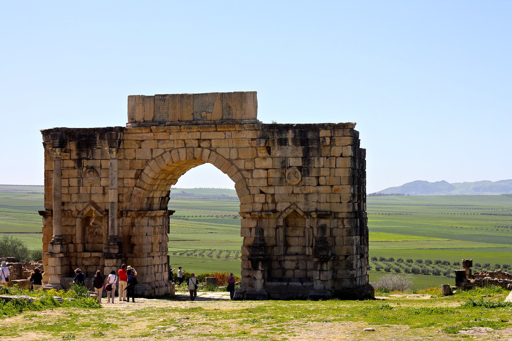
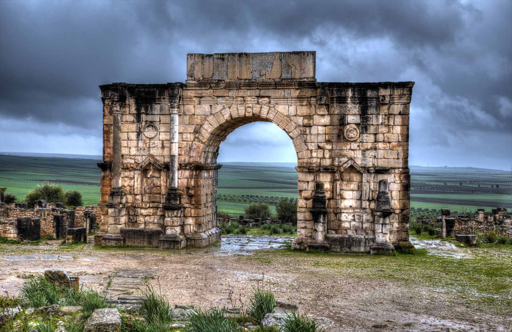
The Arch of Caracalla is one of the best-known landmarks at Volubilis.
Why Visit Volubilis?
Volubilis is worth visiting because it offers an experience that is very different from Marrakech, Chefchaouen, Fes or the Sahara Desert. You are not walking through a busy medina or following a modern city street. You are moving through the remains of an ancient Roman settlement surrounded by open countryside.
Explore Morocco’s best-known Roman ruins
Volubilis contains some of the most extensive Roman remains in Morocco. You can see a monumental arch, basilica, temples, public spaces, homes, workshops and stone roads.
Discover ancient Roman mosaics
The site is especially known for its mosaics. Many remain in their original locations, allowing you to see how decorative floors were used inside Roman houses.
Walk through an ancient city
The Decumanus Maximus, public buildings and residential areas help visitors understand how a Roman city functioned. A guide can bring the layout to life.
Combine history with northern Morocco
Volubilis works naturally with Meknes, Moulay Idriss Zerhoun, Fes or a longer cultural itinerary through northern Morocco.
Enjoy open landscapes and views
The ruins sit within a broad agricultural plain. The setting adds a quieter, more spacious atmosphere than Morocco’s crowded historic cities.
Support deeper travel
A Volubilis guided tour helps visitors see Morocco as a meeting point of African, Mediterranean, Amazigh, Roman and Islamic histories.
The Most Important Places to See in Volubilis
Volubilis is easier to appreciate when you know what you are looking at. The site includes public monuments, religious buildings, streets, houses, agricultural equipment and decorative details. You can explore independently, but a local guide helps connect each feature to the larger story of Roman Morocco.
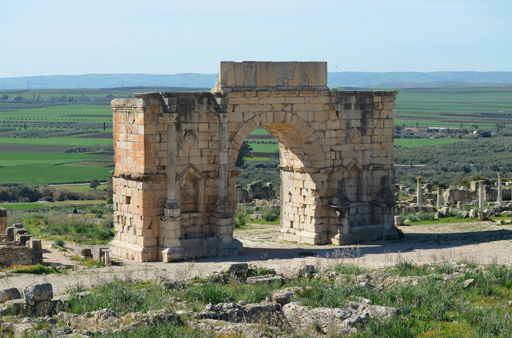
The Triumphal Arch
The Arch of Caracalla is one of the first monuments many visitors recognise at Volubilis. It marks the importance of the city within the Roman world and creates one of the site’s most memorable viewpoints.
Look beyond the arch itself. Notice its relationship to the main street, surrounding ruins and open countryside. A guide can explain why monuments like this were placed where they were and how public architecture communicated power.
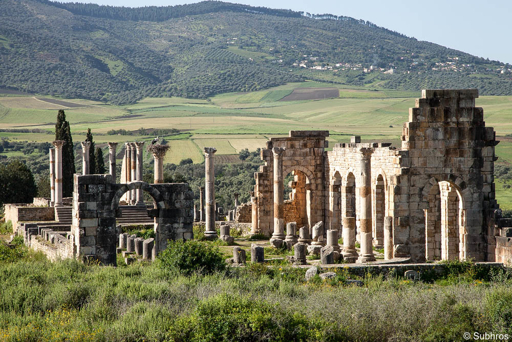
The Basilica
The Basilica was an important civic structure. In Roman cities, basilicas often supported legal, administrative and commercial life. Standing near its columns and foundations helps visitors picture public meetings and formal activity within the city.
The Basilica is close to other major monuments, making it a natural point in a guided Volubilis walking route.
The Capitoline Temple
The Capitoline Temple reflects the religious life of the Roman city. Its surviving elements help show the relationship between civic identity, public space and Roman belief.
A guide can explain how religious buildings differed from homes, baths, commercial spaces and government buildings. This makes a visit much more meaningful for travellers interested in archaeology and Roman architecture.
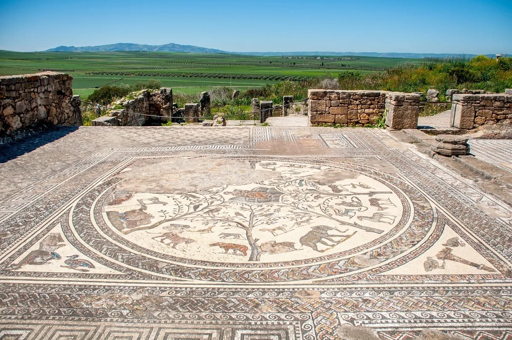
Ancient Roman Mosaics
Volubilis is famous for its mosaic floors. The designs show animals, mythological scenes, geometric patterns and decorative borders. They offer a rare glimpse into the domestic spaces of wealthy Roman residents.
Mosaics are fragile heritage. Stay on permitted paths, avoid stepping onto protected areas and follow site instructions. Good preservation allows future visitors to experience the same details.
The Decumanus Maximus
The Decumanus Maximus was the main east-west street of the city. Walking it gives you the strongest sense of Volubilis as an organised urban place rather than a collection of separate ruins.
Notice how the road connects the arch, public buildings, houses and commercial areas. It offers a simple way to understand movement, trade and civic life in the Roman city.
Roman Houses and Olive Presses
Residential buildings and olive presses reveal ordinary economic life. Olive oil production was important in the wider Roman world, and the equipment at Volubilis helps explain the city’s agricultural connection to its fertile surroundings.
These quieter ruins often become the most interesting part of a guided visit because they show how families, workers and local producers may have used the city beyond its grand monuments.
The History of Volubilis
Volubilis did not begin as a Roman city. Its story stretches across different periods of Moroccan and North African history. The site developed in a fertile part of the region, where agriculture, trade and settlement were possible long before Roman rule.
Before the Roman Empire
The area had earlier Mauretanian and local settlement history. Its fertile land and strategic location made it important for farming, trade and regional connections. This earlier context matters because Roman rule did not appear in an empty landscape; it interacted with communities and traditions already present.
Volubilis Under Roman Rule
Under Roman administration, Volubilis developed as a significant city in Mauretania Tingitana. Buildings, roads, civic monuments, temples, homes and mosaics show how Roman ideas of urban life took shape in Morocco.
Decline and Later History
Roman administration withdrew from parts of the region in late antiquity, but Volubilis did not simply disappear overnight. The area remained connected to later settlement and Islamic history. Nearby Moulay Idriss Zerhoun is especially important in the story of the Idrisid dynasty and early Morocco.
This layered history is why Volubilis feels so different from a typical “Roman ruins” visit. You are not only seeing ancient Rome. You are seeing how a Roman city existed in Morocco, how it used local agricultural land and how later Moroccan history developed in the same region.
How to Visit Volubilis
Volubilis is close to Meknes and Moulay Idriss Zerhoun and can be visited on a private day trip from Fes. The right way to visit depends on where you are staying, how much time you have, your interest in history and whether you want to combine the ruins with other places.
Visit with a local guide
A guide adds real value at Volubilis. The ruins are extensive, and signs alone cannot always explain how the city functioned. A guide can point out mosaics, public monuments, villas, olive presses and the story behind each area.
Choose a private driver
A private driver makes the day easier when you are starting from Fes, staying in Meknes or combining Volubilis with Moulay Idriss. You can travel at your own pace and avoid organising several connections.
Explore independently
Independent travel is possible, but it requires transport planning, timing and a willingness to navigate the site alone. Download an offline map, carry water and confirm current access information.
Start from Fes
Fes is a popular starting point for a Volubilis day trip because travellers often want to add Roman history to their Medina experience.
Start from Meknes
Meknes is geographically closer and works well for travellers who want to combine imperial-city heritage with archaeology and Moulay Idriss.
Build a longer Morocco itinerary
Volubilis can be part of an extended northern Morocco route with Chefchaouen, Fes, Meknes, Rabat, Casablanca or Tangier.
A Volubilis day trip from Fes can combine Roman ruins, Moulay Idriss and Meknes.
Volubilis Day Trip from Fes
A Volubilis day trip from Fes is ideal for travellers who want a break from the narrow streets of Fes el Bali and a wider view of Morocco’s history. Fes offers medieval Islamic culture, artisan workshops, food markets and one of the world’s most famous medinas. Volubilis adds Roman archaeology and open countryside.
Private transportation from Fes
The most comfortable way to visit Volubilis from Fes is usually with a private driver. You can leave from your hotel or riad, travel through the countryside, spend enough time at the ruins and continue to Moulay Idriss and Meknes if your schedule allows.
Why combine Volubilis with Meknes?
Meknes is one of Morocco’s imperial cities and provides a strong contrast with Volubilis. The Roman ruins show ancient urban life in Mauretania Tingitana, while Meknes offers monumental gates, royal architecture, markets and Moroccan history from later centuries.
Add Moulay Idriss Zerhoun
Moulay Idriss Zerhoun sits near Volubilis and is an important spiritual and historical destination in Morocco. Combining the two locations gives your day an added layer: Roman heritage at Volubilis and early Islamic history in the town associated with Idris I and the Idrisid dynasty.
If you are staying in Fes, see our Fes Medina guided tour tips before planning your wider itinerary.
Volubilis, Meknes and Moulay Idriss Tour
A Volubilis, Meknes and Moulay Idriss tour is one of the most rewarding historical day trips in northern Morocco. It combines Roman archaeology, early Islamic heritage and imperial Moroccan architecture in one carefully planned route.
Morning at Volubilis
Begin while the site is cooler and quieter. Walk the Decumanus Maximus, see the Triumphal Arch, Basilica, Capitoline Temple, villas and mosaic floors.
Midday in Moulay Idriss
Continue to the hillside town for views, lunch or a guided introduction to its place in Morocco’s spiritual and early Islamic history.
Afternoon in Meknes
Explore selected Meknes heritage sites at a comfortable pace. The exact stops depend on access, opening times and your interests.
This route is especially good for travellers who worry that Volubilis alone may not fill an entire day. By combining the ruins with Meknes and Moulay Idriss, you experience three different eras of Moroccan history without wasting time on an unplanned route.
How Much Time Do You Need at Volubilis?
Most visitors need at least two hours to see the main parts of Volubilis at a comfortable pace. Three hours or more is better if you enjoy history, archaeology, architecture or photography. You may also want extra time for a guide, rest breaks and detailed mosaic viewing.
Short visit: 1 to 1.5 hours
Suitable only if your schedule is tight. Focus on the Arch of Caracalla, the Basilica, main street and a small selection of mosaics.
Recommended visit: 2 to 3 hours
Best for most visitors. You can walk the main ruins, see key monuments, explore villas and understand the site with local context.
Deep visit: 3+ hours
Best for history lovers, students, photographers and travellers who want to walk beyond the most visited sections.
Why Choose a Private Volubilis Tour?
A private Volubilis tour gives you more control over the day. You can choose the pickup time, decide whether to include Meknes or Moulay Idriss, take photography breaks and adjust walking time for children, senior travellers or anyone who needs a slower pace.
Private driver
Avoid managing public transport connections, luggage and unfamiliar route planning between Fes, Meknes and Volubilis.
Local context
A knowledgeable guide can make ancient stones meaningful by explaining Roman homes, public life, religion, farming and mosaics.
Flexible itinerary
Spend more time at Volubilis, add Moulay Idriss, include Meknes, or continue to another northern Morocco destination.
Family-friendly pacing
Add breaks, shade, snacks and shorter walking blocks for children without needing to keep up with a large tour group.
Comfort for seniors
Discuss walking distance, uneven stone paths, shade, vehicle access and rest stops before finalising the plan.
Better use of a travel day
Combine several meaningful destinations into one route instead of using your day only for a transfer to and from the ruins.
What Should You Wear and Bring?
Volubilis is an outdoor archaeological site with stone paths, uneven surfaces, limited shade in places and changing weather. A little preparation makes the visit much more comfortable.
What to wear
- Comfortable walking shoes with good grip
- Light, breathable clothing in warm weather
- A light jacket or layer for cooler mornings and evenings
- A hat and sunglasses for sun exposure
- Respectful clothing for nearby towns and cultural visits
What to bring
- Water bottle and snacks if needed
- Sun protection, including high-SPF sunscreen
- Camera or phone with enough battery
- Small day bag with valuables secured
- Cash for tickets, food, local purchases or tips where relevant
- Any personal medication or mobility support you need
For wider packing guidance, read what to wear in Morocco as a tourist .
Best Time to Visit Volubilis
Spring and autumn are often the most comfortable seasons for visiting Volubilis because daytime temperatures are usually pleasant for walking through the exposed ruins. These seasons also work well if you plan to combine Volubilis with Fes, Meknes, Chefchaouen or a longer Morocco itinerary.
Summer can be hot, particularly around midday. Start early, bring water and allow for shade and rest. Winter can be cooler and greener, with a quieter atmosphere, but rain may make stone paths more slippery. Morning and late afternoon often provide softer light for photographs in every season.
Check current opening hours, local weather and transport conditions before travel. Museum and archaeological-site access can change, so avoid building your day around unconfirmed information.
Is Volubilis Worth Visiting?
Yes, Volubilis is worth visiting if you enjoy history, archaeology, Roman architecture, mosaics or cultural travel. It is especially rewarding when combined with Meknes and Moulay Idriss Zerhoun rather than treated as a quick, isolated stop.
Volubilis is also a good choice for travellers who have already seen the main highlights of Fes or Marrakech and want to understand a different part of Morocco. The open ruins, farmland setting and Roman history provide a strong contrast to the busy medinas.
It may be less suitable for visitors who dislike outdoor walking, strong sun, uneven surfaces or long day trips. In that case, a private itinerary helps because you can choose a slower pace, add rest stops and decide how much time to spend at each destination.
Choose Volubilis if you love
- Ancient history and Roman civilisation
- Archaeology and historic architecture
- Photography and open landscapes
- Guided cultural travel
Combine it with
- Meknes for imperial Moroccan heritage
- Moulay Idriss for early Islamic history
- Fes for Medina and craft culture
- Chefchaouen for a wider northern Morocco route
Plan extra care if
- You travel in high summer heat
- You have mobility or balance concerns
- You are travelling with very young children
- You want to combine multiple destinations in one day
Why Explore Volubilis With Morocco Live Trips?
A Volubilis visit becomes more meaningful when the day is planned around the history, your interests and your available time. Morocco Live Trips can help you create a private route that connects Volubilis with Meknes, Moulay Idriss, Fes or other northern Morocco destinations.
Local planning support
Get help deciding whether to start from Fes, Meknes or another city, and whether a one-day route is realistic for your schedule.
Private transportation
Travel comfortably with planned pickup, return arrangements and practical stops instead of managing unfamiliar connections.
Guided cultural context
Understand the ruins, mosaics, Roman streets, monuments and local Moroccan history with clearer context.
Flexible combinations
Add Meknes, Moulay Idriss, Fes, Chefchaouen or other destinations based on your travel dates and interests.
Comfortable pace
Build a route with time for walking, photographs, meals, rest stops and different group needs.
Clear booking information
Discuss transport, guide services, entrance fees, meals, timing, accommodation and all inclusions before confirming.
You can explore our wider Morocco tours , learn more about Morocco Live Trips , or build a longer Morocco guided tour itinerary .
Frequently Asked Questions About Volubilis
What is Volubilis Morocco?
Volubilis is an ancient archaeological site in northern Morocco near Meknes and Moulay Idriss Zerhoun. It is famous for Roman ruins, mosaics, streets, temples, public buildings and olive presses.
Why is Volubilis famous?
Volubilis is famous for its preserved Roman ruins, detailed mosaics, monumental Arch of Caracalla, Basilica, Capitoline Temple and its role in understanding Morocco’s Roman history.
Is Volubilis worth visiting?
Yes. Volubilis is worth visiting for travellers interested in history, archaeology, Roman architecture and cultural travel. It is particularly rewarding when combined with Meknes and Moulay Idriss Zerhoun.
Who built Volubilis?
Volubilis developed from earlier local and Mauretanian settlement history before becoming an important Roman city in Mauretania Tingitana. The ruins reflect several stages of development rather than one single building period.
What happened to Volubilis?
Volubilis changed over time as Roman administration withdrew from the region and later Moroccan history developed around it. The site was not simply abandoned in one moment; its story continued through later settlement and regional change.
How do I get to Volubilis?
You can visit Volubilis by private driver, organised guided tour or independent transport. Many travellers start from Fes or Meknes and combine the ruins with Moulay Idriss Zerhoun.
How far is Volubilis from Fes?
Volubilis can be visited as a day trip from Fes. Actual journey time depends on the route, traffic, pickup location and whether you add Meknes or Moulay Idriss.
Can you visit Volubilis from Fes in one day?
Yes. A private Volubilis day trip from Fes can include the Roman ruins, Moulay Idriss and selected Meknes highlights, depending on your preferred pace and available time.
Can I visit Volubilis and Meknes in one day?
Yes. A well-planned private day trip can combine Volubilis and Meknes, and many visitors also add Moulay Idriss Zerhoun for a wider historical experience.
Do I need a guide for Volubilis?
You can explore independently, but a guide can explain Roman buildings, mosaics, public spaces, daily life, agricultural production and the site’s relationship with Moroccan history.
How long should I spend at Volubilis?
Most visitors need two to three hours for a satisfying visit. Allow more time if you enjoy archaeology, photography, a detailed guided walk or a slower pace.
What are the main landmarks at Volubilis?
Major landmarks include the Triumphal Arch of Caracalla, Basilica, Capitoline Temple, Decumanus Maximus, Roman houses, olive presses and preserved mosaic floors.
What should I wear to Volubilis?
Wear comfortable walking shoes with grip, breathable clothing, sun protection and a light layer for changing weather. The site includes uneven stone paths and limited shade.
What should I bring to Volubilis?
Bring water, sunscreen, a hat, sunglasses, a charged phone or camera, small cash and any personal medication. A small secure day bag is useful.
Is Volubilis suitable for children?
Many families enjoy Volubilis, especially children interested in ancient cities, mosaics and open spaces. Parents should plan for heat, uneven ground, water breaks and close supervision.
Is Volubilis suitable for seniors?
It can be suitable with a realistic pace, comfortable transport, rest stops and awareness of uneven surfaces. Discuss mobility needs before arranging a private tour.
What is the best time to visit Volubilis?
Spring and autumn are often comfortable for walking. Summer visitors should start early and use sun protection, while winter can be cooler and potentially wetter.
Can I book a private Volubilis tour?
Yes. Morocco Live Trips can help organise a private Volubilis tour from Fes, Meknes or another agreed location, with options to include Moulay Idriss and Meknes.
What is included in a Volubilis tour?
Inclusions depend on the confirmed proposal and may include private transport, hotel pickup, driver, guide arrangements and planned destinations. Confirm entrance fees, meals and exclusions before booking.
How much does a Volubilis day trip cost?
Cost depends on your starting city, group size, vehicle, guide, route, entrance fees, meals and any additional destinations. Request a personalised quote for accurate pricing.
Plan Your Volubilis Tour in Morocco
Combine Volubilis, Meknes and Moulay Idriss Zerhoun in one private cultural day trip, or add the Roman ruins to a longer Morocco itinerary from Fes, Chefchaouen, Casablanca or Marrakech.
Tell Morocco Live Trips your dates, starting location, group size and interests. We will help you create a route that gives Volubilis the time and context it deserves.

Moha BN is a Moroccan-born licensed tour guide with 10+ years of experience organizing cultural tours, Sahara Desert trips, and private itineraries across Morocco. He shares local travel insights, safety advice, and budget tips through Morocco Live Trips.