The best Morocco itinerary for 7 days starts in Casablanca and ends in Marrakech, covering the Sahara Desert, Fes Medina, Chefchaouen, Ait Ben Haddou, and the High Atlas Mountains in one seamless route. No backtracking, no wasted days, no guesswork. Morocco Live Trips has run this exact circuit for years as a fully private guided tour. Everything – transport, riads, desert camp, guides – is handled for you. Read the full day-by-day guide below.
Why This 7-Day Morocco Itinerary Is Perfect for First-Time Visitors?
Most first-time visitors to Morocco make the same planning mistake. They try to see everything – Marrakech, Fes, Chefchaouen, Essaouira, Casablanca, the desert, the coast – and end up spending more time in a vehicle than in the places they came to see. Seven days is not enough for all of Morocco. It is more than enough to experience the very best of it, if the route is built correctly.
This itinerary is built correctly. It covers Morocco’s three non-negotiable experiences – the imperial cities, the Sahara Desert, and the High Atlas Mountains – and connects them in a logical geographic flow that minimises driving time and maximises time on the ground. Every day has a clear purpose and enough breathing room for the unplanned moments that Morocco is famous for.
Morocco Live Trips runs this route as a private guided tour, which means a dedicated driver, an experienced local guide, and handpicked riad accommodation at every stop. No group schedules to follow, no waiting around – just Morocco, at your own pace, done properly.
Morocco Itinerary 7 Days at a Glance
Before diving into the detail, here is the full week at a glance so you can see how the route flows:
Day 1 – Arrive Casablanca → Hassan II Mosque → drive to Rabat → overnight Rabat
Day 2 – Explore Rabat → drive to Chefchaouen → overnight Chefchaouen
Day 3 – Chefchaouen → drive to Fes → overnight Fes
Day 4 – Full day Fes Medina → overnight Fes
Day 5 – Fes → drive south → arrive Merzouga → camel trek → luxury desert camp
Day 6 – Desert sunrise → drive via Todra Gorge and Dades Valley → overnight Dades
Day 7 – Ait Ben Haddou → cross High Atlas via Tizi n’Tichka → arrive Marrakech
The route covers approximately 1,200 kilometres across seven days. Private transport with Morocco Live Trips handles every transfer, so you travel comfortably and arrive at each destination ready to explore.
Day 1: Arrive in Casablanca and Explore Rabat
Most international flights into Morocco land at Casablanca’s Mohammed V International Airport, which makes it the natural starting point for this itinerary. Your Morocco Live Trips driver meets you at arrivals and takes you straight into the city.
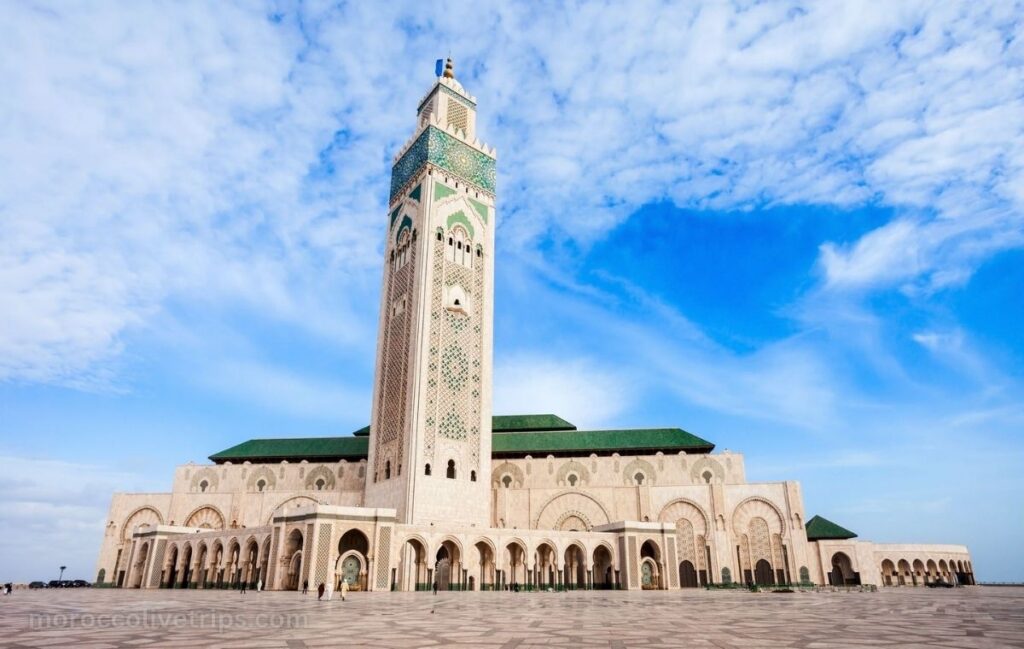
Casablanca is Morocco’s commercial capital and largest city. It is modern, fast-moving, and home to one of the most impressive buildings in Africa. The Hassan II Mosque sits on a promontory overlooking the Atlantic Ocean and is one of the few mosques in Morocco that non-Muslims can enter on a guided tour. Its minaret rises 210 metres – the tallest religious structure in Africa – and the interior can hold 25,000 worshippers. Allow 90 minutes here. It is worth every minute.
After the mosque, drive north to Rabat – Morocco’s quiet, elegant capital city, just 45 minutes from Casablanca. Rabat is one of the most underrated cities in Morocco and one of the most relaxed. Check into your riad or hotel and spend the evening walking the old medina along the river.
Day 2: Discover the Blue Streets of Chefchaouen
Start the morning in Rabat properly before heading north. The Kasbah des Oudayas is a fortified 12th-century citadel overlooking the Atlantic estuary, with blue and white painted lanes that give a first taste of what Chefchaouen will deliver in full. The Mausoleum of Mohammed V is a short walk away – an ornate royal tomb that is one of the finest examples of modern Moroccan architecture in the country.
After Rabat, drive northeast through rolling hills to Chefchaouen – the famous Blue City of Morocco, set in the Rif Mountains at around 600 metres elevation. The drive takes approximately two and a half hours and the road climbs steadily through pine forests as you approach the city. Arriving in Chefchaouen in the late afternoon gives you the best light for your first walk through the blue medina lanes – golden hour here, with soft light bouncing off cobalt walls, is one of Morocco’s great visual experiences.
Check into your riad in the medina and spend the evening in the central plaza. Chefchaouen has a noticeably calmer pace than any other Moroccan city, and your first evening here – a quiet dinner, a walk through the empty blue streets after dark – sets the tone perfectly.
Day 3: Explore Chefchaouen then Drive to Fes
Wake up early and spend the morning in Chefchaouen before the day-trippers arrive from Fes and Tangier. The upper medina lanes around the old mosque are the most photographed spots in Morocco, and before 8am you often have them almost entirely to yourself. Walk the staircase alleys, explore the 15th-century kasbah and its small ethnographic museum, and have breakfast at one of the terrace cafés overlooking the central square.
After a full morning, drive southeast to Fes – approximately two and a half hours through the Rif Mountain foothills. Fes is Morocco’s oldest imperial capital and the most intense cultural experience the country offers. Arrive in time for a late lunch in the medina and an afternoon walk through the edge of the Fes Medina to get your bearings before the full day exploration tomorrow. Check into your riad inside the medina walls – waking up inside Fes el-Bali the following morning is an experience that sets up the whole day differently.
Day 4: Full Day in the Ancient Medina of Fes
Give Fes a full day. It deserves it, and one day is already not quite enough – but one well-guided day inside Fes el-Bali will leave you with a deeper understanding of Moroccan history and culture than almost any other single experience on this itinerary.
Fes el-Bali is a UNESCO World Heritage Site and the largest car-free urban area in the world. Its 9,000 streets have been largely unchanged since the 12th century, and 150,000 people still live and work inside its walls. Without a guide, the medina is genuinely disorienting – there is no comprehensible grid, no landmarks visible above the rooftops, and solo travellers reliably get lost for hours. With a good local guide, it reveals itself completely. Morocco Live Trips provides an expert Fes medina guide as part of this day.
Start at the Chouara Tannery in the morning. This is Morocco’s most iconic image – the ancient stone dyeing vats filled with natural colours, workers standing knee-deep treading leather using methods unchanged since the 11th century. Viewing from the rooftop terraces of the surrounding leather shops gives you the full panoramic scene. Spend the afternoon in the souk quarter – the leatherworkers, the woodworkers, the brass-beaters, the spice merchants – before visiting the Bou Inania Madrasa, a 14th-century Quranic school with some of the finest carved plasterwork and cedar woodwork in Morocco. End with a slow walk and dinner in the medina.
Day 5: Drive South to Merzouga and the Sahara Desert
Today is the longest driving day of the itinerary – approximately five to six hours from Fes to Merzouga – and it is also one of the most scenic. The route crosses the Middle Atlas Mountains through cedar forests where wild Barbary macaque monkeys sit by the roadside, drops into the Ziz Valley with its endless palm groves, and arrives eventually at the edge of the Sahara Desert as the land flattens out and the first dunes of Erg Chebbi appear on the horizon.
Arrive in Merzouga in the early to mid-afternoon with enough time to settle at your desert camp before the camel trek begins. At sunset you mount a camel and ride out into Erg Chebbi – the golden dune field that rises to over 150 metres at its highest point. The light at this hour turns the sand deep orange, the shadows stretch long and clean, and the silence is absolute. It is the kind of experience that does not require any description once you are inside it.
Your night is spent in a luxury desert camp – a proper bed inside a beautifully decorated Berber tent, a candlelit dinner under the open sky, and traditional music played around a fire as the temperature drops and the stars above you multiply into the millions. This is the night of the entire trip that most Morocco Live Trips guests say they remember first when they get home.
Day 6: Desert Sunrise, Todra Gorge, and the Dades Valley
Wake up before dawn and climb the nearest dune for sunrise over Erg Chebbi. The dunes shift colour in minutes as the light arrives – deep purple to orange to pale gold – and the silence during those first few moments of daylight is something that stays with you long after the trip ends. This is non-negotiable. Set your alarm.
After breakfast at the camp, drive west via Erfoud and into the dramatic landscapes of southern Morocco. The first major stop is Todra Gorge – a narrow canyon carved through the High Atlas foothills by the Todra River, with walls rising 300 metres on either side and a thin strip of sky visible above. Local rock climbers use the gorge year-round and the floor of the canyon is cool and shaded even in summer. Allow an hour to walk through it.
Continue west along the Route des Kasbahs through the Dades Valley – one of Morocco’s most beautiful drives, a long winding road through a valley of red rock cliffs, ancient kasbahs, and rose gardens that bloom every spring. The valley villages are quiet and unhurried, and the light on the red rock in late afternoon is extraordinary. Overnight in a guesthouse or riad in the Dades Valley.
Day 7: Ait Ben Haddou, High Atlas Pass, and Marrakech
The final day delivers two of Morocco’s most dramatic experiences back to back. Drive west from the Dades Valley toward Ouarzazate – Morocco’s film industry hub, known as the Hollywood of Africa, where epic productions including Gladiator, Game of Thrones, and Lawrence of Arabia were filmed.
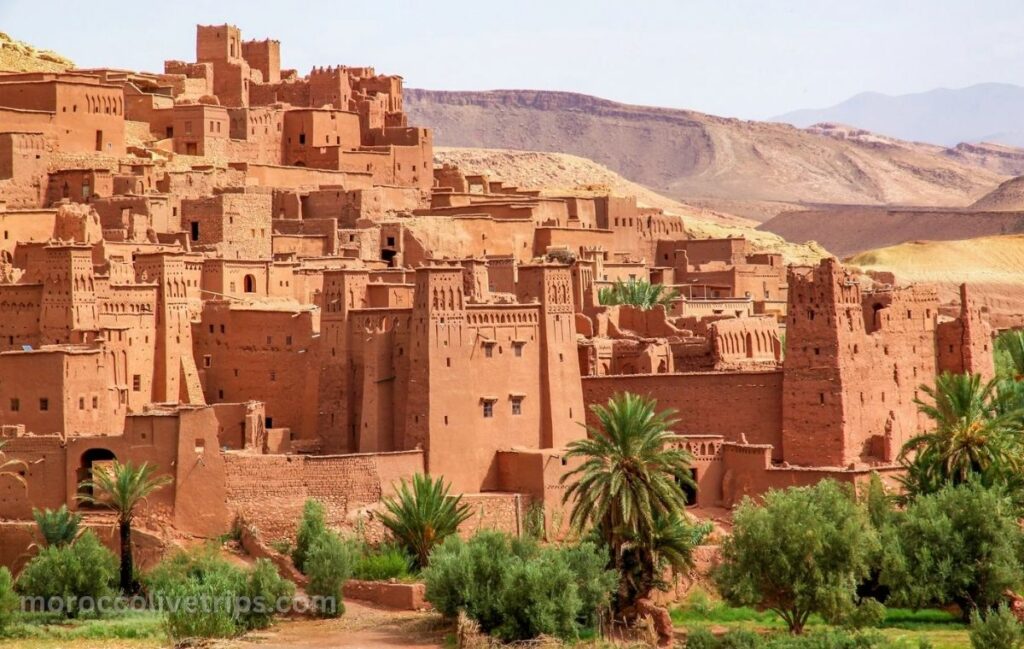
Just before Ouarzazate, stop at Ait Ben Haddou – a UNESCO World Heritage Site and one of the most visually striking places in Morocco. This ancient fortified village, built from mud brick and rising in tiers above the Ounila River, has appeared in more major films and television series than almost any other location outside Hollywood. Walking through its lanes and climbing to the top for the panoramic view across the valley takes about an hour and is completely worth it.
From Ait Ben Haddou, the road climbs north through the High Atlas Mountains via the Tizi n’Tichka Pass – at 2,260 metres, the highest paved mountain pass in Morocco. The drive over the pass is spectacular in every direction, with mountain villages clinging to steep slopes and views across ranges that stretch to the horizon. The descent brings you through the foothills and out onto the Marrakech plain, arriving in the city by late afternoon. Check into your riad, walk to Jemaa el-Fnaa as the evening market comes alive, and let Marrakech do what it always does to first-time visitors.
Attractions Covered During This 7-Day Morocco Itinerary
This route covers more genuine highlights per day than almost any other 7-day Morocco circuit available. In one week you experience: the Hassan II Mosque in Casablanca, the Kasbah des Oudayas and royal mausoleum in Rabat, the blue medina of Chefchaouen, a full day in the ancient Fes Medina including the Chouara Tannery, camel trekking and a luxury overnight in the Sahara Desert at Erg Chebbi, the Todra Gorge, the Dades Valley route des kasbahs, the UNESCO-listed Ait Ben Haddou kasbah, the Tizi n’Tichka mountain pass, and arrival into Marrakech for the final evening.
Every stop on this route is genuinely significant. Nothing is included to pad the schedule – each location earns its place.
Estimated Travel Time Between Cities
Understanding the driving distances helps you plan each day’s energy levels realistically.
Casablanca to Rabat: 45 minutes by road. Easy first transfer after a long-haul flight.
Rabat to Chefchaouen: Approximately 3 hours. A comfortable morning drive through Northern Morocco.
Chefchaouen to Fes: Approximately 2.5 hours. Scenic mountain road through the Rif foothills.
Fes to Merzouga: Approximately 5.5 to 6 hours. The longest day, broken up by the Atlas scenery and monkey forest stops.
Merzouga to Dades Valley: Approximately 3.5 hours including the Todra Gorge stop.
Dades to Marrakech via Ait Ben Haddou: Approximately 4 to 4.5 hours including the kasbah visit and mountain pass.
All transfers on Morocco Live Trips tours are in private, air-conditioned vehicles with an experienced driver who knows every road on this route. The driving days are manageable, the scenery makes the time pass quickly, and stops are built in wherever the landscape demands them.
Best Time to Visit Morocco for This Itinerary
Morocco is a year-round destination, but the timing of your visit significantly affects the experience – particularly in the desert and the mountains.
Spring (March to May) is the single best time to follow this itinerary. Temperatures are comfortable across all regions – warm in the south, mild in the north – and the landscape is at its most varied and colourful. The Dades Valley rose gardens bloom in April, which makes the valley drive particularly beautiful.
Autumn (September to November) is a close second. The intense summer heat has passed, the crowds are lighter than in spring, and the desert nights are cool and comfortable. This is an excellent time for travellers who want the Sahara experience without the extreme daytime heat.
Winter (December to February) works well for the desert and the imperial cities, but the Tizi n’Tichka Pass can occasionally close due to snow, and Chefchaouen in the Rif Mountains is noticeably cold at altitude. Travel insurance that covers road delays is recommended for winter travel.
Summer (June to August) brings intense heat to the south – Merzouga regularly reaches 42°C in July and August. The desert experience is still possible but demanding. Most Morocco Live Trips guests who travel in summer adjust the desert day to begin the camel trek at 4pm rather than sunset to avoid the peak heat.
How Much Does a 7-Day Morocco Trip Cost?
The cost of a 7-day Morocco itinerary depends significantly on your travel style, group size, and what is included in your package. Here is a realistic breakdown.
Budget independent travel – staying in cheaper guesthouses, using shared transport where available, and eating local – runs from roughly £45 to £70 per person per day, excluding flights. This approach is possible but challenging on this specific route, as the Fes to Merzouga leg in particular is very difficult without private transport.
Mid-range private guided tour – private vehicle, mid-range riad accommodation, breakfast daily, and a local guide for the medina days – runs from approximately £120 to £180 per person per day based on two people sharing. This is the category most Morocco Live Trips guests fall into, and it represents excellent value for what is included.
Luxury private tour – private vehicle, handpicked luxury riads, full-board at the desert camp, spa treatments, and a dedicated guide throughout – runs from £220 to £350 per person per day. For groups of four or more, the per-person cost at every level drops noticeably.
Flights from the UK to Casablanca with Royal Air Maroc, easyJet, or Ryanair typically run from £80 to £200 return depending on the season and how far in advance you book. Moroccan dirhams are the local currency and cash is necessary in smaller towns and souks – budget £15 to £25 per day for personal spending.
This guide on budgeting for a desert adventure will help you avoid unexpected expenses during your trip.
What to Pack for a One-Week Morocco Trip?
Packing for Morocco takes a little thought because the itinerary crosses multiple climates – coastal north, mountain passes, and Sahara desert – in a single week.
Clothing: Lightweight, breathable layers that cover your shoulders and knees for medina visits and mosque areas. A warm layer for the desert night and mountain pass – temperatures drop sharply after dark even in summer. Comfortable walking shoes that you do not mind getting dusty.
Sun protection: High-factor sunscreen is essential, particularly for the desert day. A wide-brimmed hat and UV-protection sunglasses matter more in the Sahara than anywhere else on this route.
Essentials: A small daypack for medina walks, a reusable water bottle, a power bank for long driving days, and a universal travel adapter. Moroccan plug sockets use European-style two-pin plugs.
Cash: Withdraw Moroccan dirhams at the airport in Casablanca or at an ATM in Rabat. Card acceptance is improving in Morocco but remains unreliable in smaller towns, souks, and desert camps. Having £100 to £150 in dirhams available at all times removes any stress on this route.
Explore our complete Morocco outfit guide for practical clothing tips and local dress advice.
Essential Morocco Travel Tips
A few practical points that make a real difference on a 7 days in Morocco itinerary.
Book your desert camp in advance. The best luxury camps at Erg Chebbi have limited capacity and fill up weeks ahead during peak season. Morocco Live Trips handles this as part of every tour package, but independent travellers should book at least six to eight weeks ahead for spring and autumn travel.
Use a guide in Fes. The Fes Medina is the one place on this entire itinerary where a local guide is not optional but essential. The 9,000-street medieval city has no comprehensible navigation logic, and without guidance you will spend your single Fes day getting lost rather than experiencing it. Morocco Live Trips includes a professional Fes medina guide on all tours.
Carry small denomination dirhams. Tipping is standard and appreciated throughout Morocco – guides, drivers, camp staff, and riad staff all rely on tips as part of their income. Having small notes available means you can tip naturally and appropriately without needing change.
Respect local customs. Morocco is a Muslim country and dressing modestly – shoulders and knees covered in medinas, mosques, and rural areas – is both respectful and practical. Alcohol is available in tourist restaurants and licensed hotels but is not served everywhere. Public displays of affection are best kept to a minimum outside tourist zones.
Do not overplan your days. The best moments on any Morocco trip are the unplanned ones – the conversation with a carpet merchant that turns into a two-hour education about Berber weaving, the side street in the medina that leads to a courtyard you were not looking for, the tea that appears from nowhere and turns into the best hour of the trip. Leave space for these things to happen.
Frequently Asked Questions About This 7-Day Morocco Itinerary
Is 7 days enough for Morocco?
Seven days is enough to experience Morocco’s essential highlights – the imperial cities, the Sahara Desert, the High Atlas Mountains, and Marrakech – if the itinerary is well-structured and you use private transport between destinations. You will not see everything Morocco offers in a week, but you will see enough to understand why people return.
What is the best 7-day Morocco itinerary?
The best route for first-time visitors runs from Casablanca through Rabat, Chefchaouen, and Fes in the north, then south to Merzouga and the Sahara Desert, returning via the Dades Valley, Ait Ben Haddou, and the High Atlas Mountains to Marrakech. This is the circuit Morocco Live Trips recommends and runs as a private guided tour.
Should I start in Casablanca or Marrakech?
Starting in Casablanca and ending in Marrakech gives you the most logical geographic flow for a 7-day Morocco circuit. It means you travel in one direction rather than doubling back, and it saves significant time. Flying in to Casablanca and out of Marrakech is the most efficient routing for this itinerary.
Can you visit the Sahara Desert in 7 days?
Yes, and this itinerary includes a full desert night at Erg Chebbi near Merzouga – camel trekking at sunset, overnight in a luxury desert camp, and sunrise over the dunes the following morning. The Sahara is fully achievable in a 7-day Morocco itinerary with the right route and private transport.
Is a private Morocco tour worth it?
For a 7-day itinerary that covers this much ground, yes – without question. Public transport in Morocco cannot connect these destinations efficiently within a week. A private tour with an experienced driver, local guides, and pre-arranged accommodation removes every logistical stress and maximises the time you spend experiencing Morocco rather than trying to navigate it.
Can I visit Chefchaouen in one week?
This itinerary includes an overnight stay in Chefchaouen and a full morning to explore the blue medina before driving to Fes. One full morning in Chefchaouen is enough to see its highlights without rushing – the photography spots, the kasbah, the central plaza, and the upper medina lanes.
Is Morocco safe for tourists?
Morocco is one of the safest countries in North Africa for international tourists. It is a stable, politically moderate country with a well-developed tourism infrastructure and a culture of genuine hospitality toward visitors. Morocco Live Trips has been operating tours throughout the country without incident for years, and our guides and drivers know every area on this route personally. Complete Safety Guide is here…
Is this itinerary suitable for families?
Yes. Morocco Live Trips regularly runs this circuit with families including young children. The route offers varied daily experiences that engage children at every age – camel rides, mountain scenery, ancient kasbahs, and the souks. We can adjust the pace and accommodation choices to suit family needs on any booking.
Why Book Your Morocco Itinerary with Morocco Live Trips?
Planning a 7-day Morocco itinerary independently is possible. Executing it well – with the right driver, the right riads, the right guide in Fes, the right desert camp before it books up, and the right pace through each day – is where most independent travellers run into problems. Morocco rewards experience. It rewards local knowledge. And it rewards having someone in your corner who has done this route dozens of times and knows every detail that makes the difference between a good trip and an unforgettable one.
Morocco Live Trips is a licensed Morocco tour operator. We handle every element of this itinerary – private air-conditioned transport throughout, handpicked riad accommodation at every stop, professional local guides in Fes and Marrakech, luxury desert camp reservation, and full flexibility to adjust the pace or add experiences based on what you want. Our guests arrive and leave, and we take care of everything in between.
With the 2030 FIFA World Cup coming to Morocco, demand for quality private tours is rising fast and the best camps, riads, and guides are booking up months in advance. The earlier you plan, the better your options. Contact Morocco Live Trips today – tell us your dates, your group size, and what matters most to you, and we will build your perfect 7-day Morocco itinerary from the ground up.
Ready to book this exact itinerary as a private guided tour? See our 7-day tour from Casablanca package with full inclusions and pricing.
Moha BN is a Moroccan-born licensed tour guide with 10+ years of experience organizing cultural tours, Sahara Desert trips, and private itineraries across Morocco. He shares local travel insights, safety advice, and budget tips through Morocco Live Trips.